

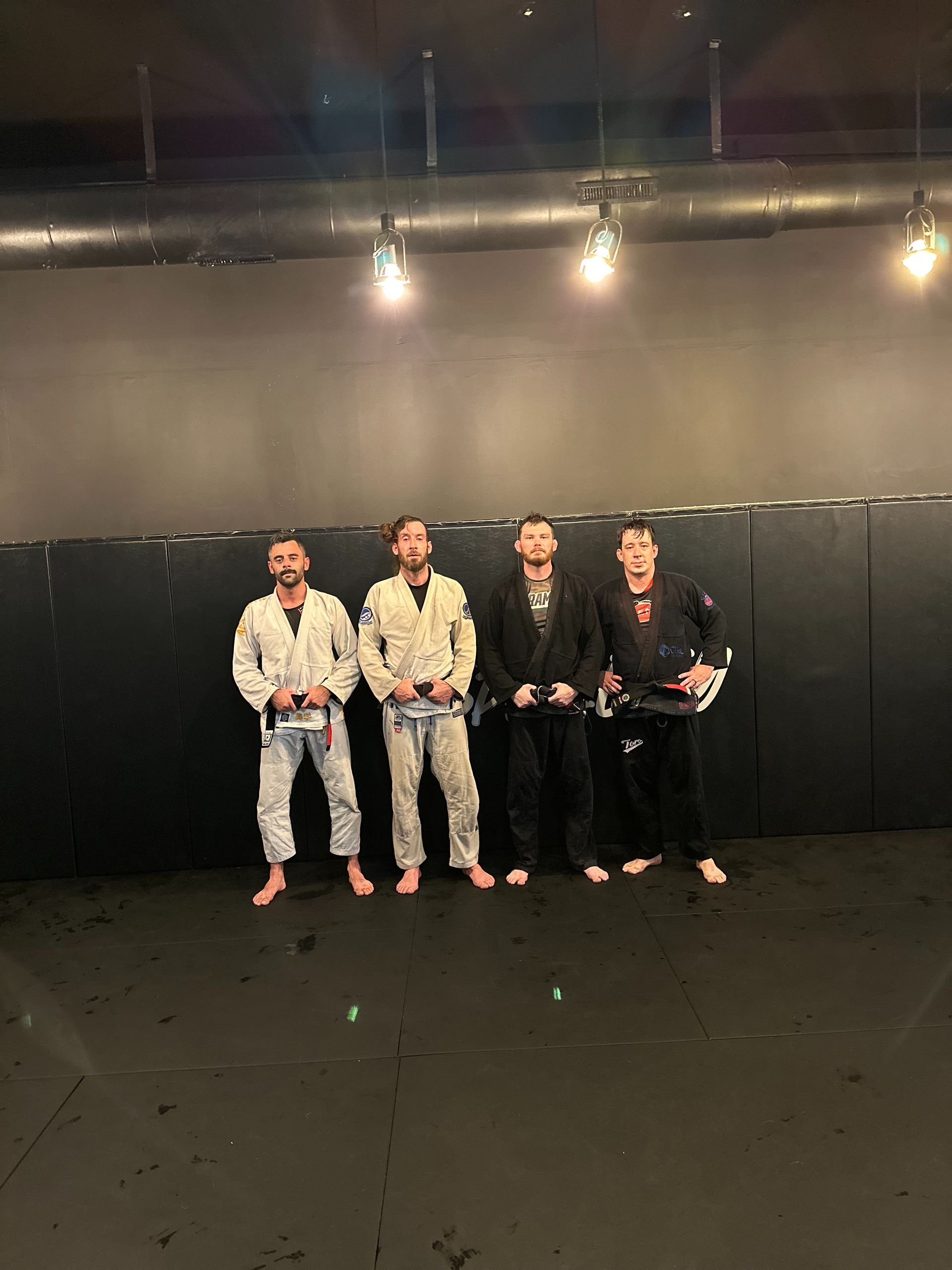
Jiu-Jitsu gives you practical control, calm decision-making, and confidence that carries into everyday Asheville life.
Asheville has a way of pulling you outside. You hike, you bike, you chase sunsets off the Parkway, and you try to keep your body feeling good enough to do it all again next weekend. But a lot of locals are also looking for something more grounded than “just a workout” - something that builds real-world capability, not only cardio.
That’s where Jiu-Jitsu fits. It’s a skill you can actually use, taught through repeatable positions and problem-solving instead of guesswork. And because the art is built on leverage and control, it’s accessible for a wide range of ages, sizes, and starting points.
In our classes, we see the same pattern again and again: people come in for fitness or self-defense, and they end up staying for the clarity it brings. You learn how to stay calm under pressure, how to move with intention, and how to make decisions when your heart rate is up. That is a rare kind of training.
Why Jiu-Jitsu feels especially relevant in Asheville right now
Asheville is friendly, creative, and wellness-focused - but it’s also a city with crowds, nightlife, busy sidewalks, and the occasional unpredictable moment. Locals don’t necessarily want to feel anxious about that. We want to feel prepared, without living on edge.
Jiu-Jitsu helps because it’s practical at close range, where most real confrontations actually happen. It teaches you how to manage distance, secure control, and protect yourself when things get messy, fast. And it does it in a way that isn’t based on being the biggest or strongest person in the room.
There’s also the lifestyle match. Many students already do yoga, lift, or spend weekends on trails. Jiu-Jitsu slides into that routine as a skill-based practice: physical, yes, but also technical and mental. The learning curve keeps you engaged, and the training keeps you honest.
A skill-first approach, not a “fight club” vibe
A common concern we hear is that Jiu-Jitsu sounds intense. It can be, but intensity doesn’t have to mean chaos. Our day-to-day training is structured: you learn technique, you drill it, and you add resistance gradually so your skills hold up under pressure.
That progression is what makes it feel “real.” You’re not just watching moves. You’re building habits your body can recall when you’re tired, stressed, or surprised.
The real-world skills locals want (and what training actually builds)
“Self-defense” is the headline, but the deeper value is competence. When you train consistently, you develop a set of capabilities that show up everywhere: posture, awareness, boundaries, composure, resilience.
Here are the practical outcomes we focus on, without turning training into a lecture.
Control and leverage: the heart of Jiu-Jitsu
Jiu-Jitsu is often described as the art of controlling an opponent with technique, not brute strength. In practice, that means you learn:
• How to base and balance so you don’t get easily pushed, pulled, or toppled
• How to escape bad positions on the ground (where many untrained people freeze)
• How to use frames, angles, and timing to create space
• How to hold top control without relying on athleticism alone
We teach these concepts through positions you’ll revisit constantly, because repetition is what makes the skill reliable.
Calm under pressure (it’s not just motivational talk)
When you spar safely, you experience pressure in a controlled environment. Someone is trying to pass your guard. You’re working to stand up. Your breathing changes. Your brain wants to rush.
Then you learn to slow down anyway.
That ability to self-regulate is a real-world skill, whether you’re dealing with a tense conversation, a stressful job situation, or the simple chaos of everyday life. Training gives you a place to practice staying functional when your body is stressed.
Fitness that doesn’t feel like punishment
A lot of people in Asheville want to be fit, but not bored. Jiu-Jitsu is sneaky that way: you’re so focused on solving the “puzzle” in front of you that you forget you’re working hard.
You build strength through grappling-specific movement, grip endurance, core stability, and hip mobility. And because training is scalable, you can push your pace when you feel good, or dial it back and still learn when you’re not at 100 percent.
What “beginner-friendly” should actually mean
Saying a class is beginner-friendly is easy. The real test is what happens in the first few weeks, when you don’t know the language yet and every position feels unfamiliar.
We take beginners seriously. That means we teach fundamentals in a way that’s simple without being watered down. You’ll learn how to move on the mats, how to stay safe, and how to ask good questions. And you’ll get coached through the awkward parts, because yes, there are awkward parts.
What you’ll learn early on
In the first phase of training, we focus on building a foundation that makes everything else easier. Expect to spend time on:
• Basic escapes and survival principles so you can stay composed in bad spots
• Positional control so you understand where safety and leverage come from
• Guard concepts that teach distance management and protection
• Takedown and clinch awareness, especially with our wrestling influence
• Simple submissions and, more importantly, how to apply them responsibly
If you’re looking for adult Jiu-Jitsu in Asheville and you’re worried you’ll be “behind,” we’ll be blunt: nobody starts ahead. Everyone starts by showing up.
Why wrestling makes the training feel more complete
One reason locals gravitate toward our approach is that we don’t treat stand-up as an afterthought. Wrestling changes how you see distance, pressure, and control. It teaches you how to stay balanced, how to hand-fight, and how to finish takedowns with mechanics instead of panic.
Even if your main goal is Jiu-Jitsu, wrestling concepts help you:
• Close distance safely instead of reaching
• Understand posture and head position in clinches
• Build the kind of pressure that works without muscling
• Develop timing and confidence on the feet
For people who want practical skills, that matters. Real encounters don’t start on the ground with a respectful slap and bump. Learning how to manage the stand-up phase adds realism, and it makes you more well-rounded.
The community effect: why people keep coming back
The technical side is important, but most adults don’t stick with a hard hobby unless the environment supports it. In our space, you’ll find a mix of beginners and advanced students, and that blend matters. When higher-level teammates train with control, newer people learn faster and feel safer.
We also hear something that’s easy to overlook: people genuinely look forward to training. Reviews often mention how supportive the room feels, how clearly techniques are explained, and how much progress happens with consistent coaching. That’s not accidental. Culture is built, one class at a time.
Real feedback we hear from students
We’re proud of our 5-star rating from 100 plus reviews because the comments reflect the things we care about most: clear instruction, a welcoming vibe, and training that changes lives in practical ways. Some students even describe the experience as life-saving, which is a heavy statement - but it points to something real. When you build competence and community at the same time, people feel steadier.
Common questions about Jiu-Jitsu in Asheville
Is this only for athletes?
No. You’ll meet athletes, sure, but you’ll also meet busy parents, service industry folks, students, and professionals who just want something that works. We coach technique first, and you scale intensity to your body.
What if I’m not in great shape?
You don’t need to “get in shape” before you start. Training is how you build conditioning. Your first goal is consistency, not perfection.
Is it safe?
Jiu-Jitsu is contact training, so safety depends on structure and behavior. We emphasize tapping early, training with control, and learning how to protect your body. You’ll be coached on pace and partner selection, especially early on.
What should I expect on day one?
Expect to feel a little out of your element at first, in a normal way. You’ll warm up, learn technique, drill with a partner, and depending on the class, you may do light positional rounds. You can always opt out of anything that doesn’t feel right while you learn the ropes.
How to get started without overthinking it
If you’re curious, the simplest approach is to try a class and treat it like information gathering. You don’t need fancy gear on day one. You just need a willingness to learn, and the patience to be new at something.
Here’s the best way to make your first week smooth:
1. Check the class schedule and pick a session you can attend consistently
2. Arrive a little early so we can get you oriented and answer questions
3. Focus on learning positions and safety habits, not “winning” anything
4. Keep your effort at a level where you can breathe and think
5. After class, note what felt confusing so we can help you next time
Consistency is the secret. Two classes can feel like chaos. Ten classes starts to feel like a map.
Real-world skills you can measure over time
One reason adults love this training is that progress becomes visible. Not overnight, but steadily. You’ll notice:
• You recover faster after hard rounds
• You recognize positions instead of guessing
• You stop holding your breath under pressure
• You move with better posture in daily life
• You feel more confident setting boundaries
That’s what we mean by real-world skills. Jiu-Jitsu gives you a practice that shows up outside the mats, even when you’re not thinking about it.
## Ready to Begin
If you want Jiu-Jitsu in Asheville that’s practical, structured, and welcoming, we’ve built our training to meet you where you are and help you grow from there. You can come in as a total beginner, train with experienced coaching, and develop skills that translate into confidence, fitness, and real capability.
We do that every day at Speakeasy Jiu-Jitsu & Wrestling Academy, right here in Asheville, and we’d love to help you take the first step in a way that feels comfortable and straightforward.
Put these techniques into practice by joining a Jiu-Jitsu class at Speakeasy Jiu-Jitsu & Wrestling Academy.