

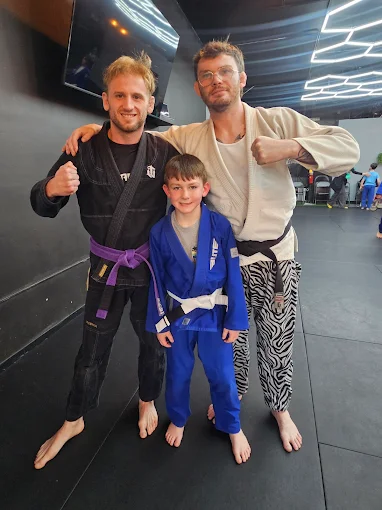
Jiu-Jitsu turns fitness into a skill you can feel, measure, and use every time you step on the mat.
If you have ever tried to “just get in shape,” you already know the frustrating part: motivation fades when workouts feel repetitive. Jiu-Jitsu solves that problem in a practical way because every round has a purpose. You are not only burning calories, you are learning leverage, timing, balance, and calm decision-making under pressure.
Here in Asheville, we see students walk in with all kinds of goals. Some want strength without living in the weight room. Some want better focus for work, school, or parenting. Others want a physical outlet that actually clears the mental clutter. The common thread is simple: Jiu-Jitsu gives you a full-body training session and a mental reset, all in one class.
This guide breaks down how the training improves conditioning, strength, and focus, what a typical learning path looks like, and how our programs fit beginners, experienced athletes, and families looking for kids Jiu-Jitsu in Asheville.
Why Jiu-Jitsu feels different from “regular” fitness
Most fitness plans focus on output: lift more, run faster, do more reps. Jiu-Jitsu still builds output, but it starts with efficiency. When you learn to move your hips correctly, keep posture, frame with your arms, and breathe under stress, the body changes are almost a side effect of better mechanics.
Another difference is built-in variety. You can practice technique, drill with a partner, work situational rounds, and then roll (spar) in a controlled environment. Even when the class structure is consistent, the experience never repeats exactly because your training partner is a living puzzle. That keeps you engaged, and consistency is what makes fitness stick.
And yes, it is challenging. The first few weeks can feel like learning a new language. But that challenge is also the hook: you improve quickly when you show up, and you can feel those improvements in real time.
Strength gains you can actually use
Grip, core, and “real-world” strength
Jiu-Jitsu builds the kind of strength people notice when they carry groceries, pick up kids, move furniture, or spend hours at a desk without feeling wrecked. A lot of that comes from isometric strength, meaning you are bracing and holding positions while you move someone who is actively resisting.
Your hands and forearms get stronger from gripping, posting, and controlling. Your core develops from constant rotation, hip movement, and the need to stabilize while changing angles. Your back and hips get stronger because good grappling posture is not optional, it is survival.
If you want a simple way to picture it, think of Jiu-Jitsu as strength training where the “weight” shifts, pushes back, and forces you to coordinate your whole body.
Strength without unnecessary strain
We coach you to rely on technique and positioning rather than muscling through everything. That matters because it lets you train consistently. Consistency is where results come from, and it is also where confidence comes from. Over time, you learn when to apply force and when to relax, which is a skill many athletes never develop in traditional workouts.
Research on Brazilian Jiu-Jitsu has also found improvements in muscular strength, endurance, and overall fitness markers in regular practitioners. That lines up with what we see week after week: students who train steadily get stronger, leaner, and more capable.
Cardio that sneaks up on you (in a good way)
Jiu-Jitsu conditioning is different from jogging or cycling because the intensity changes constantly. You will have moments of steady movement, sudden scrambles, and periods where you have to slow your heart rate down while still working. That teaches your body to recover under pressure, which is a useful kind of fitness for everyday life.
People often assume they need to “get in shape first” before trying Jiu-Jitsu in Asheville. We do not recommend waiting. We scale training appropriately, and you can control intensity by choosing how hard you roll and by focusing on positional rounds. Your cardio improves because you train, not because you avoided training until you felt ready.
Flexibility, mobility, and joint resilience
Mobility is one of the most underrated benefits of consistent grappling. Hips open up. Thoracic spine rotation improves. You start paying attention to how you move through space, not just how much weight you can lift.
We also emphasize warm-ups and movement patterns that support safe training: hip escapes, shoulder mobility, controlled falls, and technical stand-ups. These are not just “martial arts moves.” They are durability skills. They help your body handle awkward angles, sudden shifts, and the kind of daily stumbles that happen when life is busy.
Some studies have reported improvements in flexibility and other health markers for regular Brazilian Jiu-Jitsu trainees, including blood pressure changes. We never treat training as medical care, but the pattern is clear: consistent movement, smart intensity, and good coaching often lead to better overall health.
Focus training: why your mind gets sharper on the mat
Problem-solving under pressure
Every exchange in Jiu-Jitsu is a decision tree. Where are your frames? How is your base? Which direction is the escape? What happens if your partner shifts weight? This constant problem-solving forces you to stay present. You cannot multitask while someone is trying to pass your guard.
That presence carries over. Many students tell us they feel calmer after class, not hyped up. The brain gets a break from open tabs and unfinished tasks because it has to focus on one thing at a time.
Building resilience and self-efficacy
Jiu-Jitsu is also a safe place to practice discomfort. You will get stuck. You will tap. You will have rounds where nothing works, and then a week later the same situation suddenly makes sense. That process builds resilience because progress is earned through repetition, not perfection.
Research has linked regular training with improved mental toughness, grit, and self-efficacy, and higher ranks often report better life satisfaction than beginners. We see why: you learn that effort compounds. You learn to stay calm, keep breathing, and try again with a better plan.
What to expect in our classes (and why it works)
We keep training structured so you can track progress, but flexible enough that you do not feel boxed in. A typical class includes technique instruction, drilling, and live rounds that match your experience level.
Here is what we focus on, especially for beginners, so you build skill and fitness at the same time:
• Movement fundamentals like hip escapes, bridging, and technical stand-ups to build body control and endurance
• Positional skills such as maintaining base, posture, and frames so you do not rely on strength alone
• High-percentage submissions and escapes that teach safe mechanics and timing
• Controlled sparring that helps you apply technique while keeping intensity appropriate
• A training culture where questions are normal and progress is measured in small wins
If you are new, we help you understand what matters most: survive positions, protect yourself intelligently, and gradually add offense. Fitness improves as a result of learning to move well.
A realistic progression: how strength and focus build over time
People sometimes want a dramatic before-and-after story. Real progress is quieter than that, but it is more reliable. Most students follow a pattern that looks like this:
1. Weeks 1 to 4: You learn basic movement, terminology, and how to stay safe while rolling. Your cardio wakes up fast.
2. Months 2 to 4: You start recognizing positions, escaping more often, and using less brute force. Strength and coordination begin to “click.”
3. Months 5 and beyond: You build a personal game, notice sharper focus off the mats, and recover faster between rounds. Training becomes part of your routine.
This timeline is not a rule, but it is common. The big takeaway is that Jiu-Jitsu rewards consistency. Even two or three classes per week can change how you feel in your body and how you handle stress.
Kids Jiu-Jitsu in Asheville: confidence, coordination, and calm
Kids need movement, structure, and a place where effort is praised more than “being the best.” Our kids program is designed to teach practical grappling skills while building habits that help at home and school.
We coach kids to listen, follow directions, and work with partners respectfully. The mats are a place to practice self-control, not chaos. Over time, kids develop better balance, coordination, and body awareness, and many parents notice improved confidence and emotional regulation.
Jiu-Jitsu is also social in a healthy way. Training partners matter. Kids learn how to win and lose appropriately, how to reset after a tough round, and how to keep trying. Those lessons land because they are experienced, not lectured.
If you are specifically looking for kids Jiu-Jitsu in Asheville, we recommend starting with a consistent schedule and letting your child settle in. The first few classes are an adjustment, and then something shifts. They stop watching the clock and start asking what they can learn next.
Common concerns we hear (and how we handle them)
“I’m not athletic enough.”
You do not need to be athletic to start Jiu-Jitsu. You build athleticism through training. We scale intensity, pair you appropriately, and teach you how to move efficiently first.
“I don’t want to get hurt.”
Safety is part of good coaching and good culture. We emphasize tapping early, training with control, and learning positions before going hard. You are never expected to “prove” yourself.
“I’m nervous about sparring.”
That is normal. We introduce live rounds progressively, and positional training gives you a way to practice without feeling thrown into the deep end. You will have options.
“Will this help me lose weight?”
Jiu-Jitsu can support weight loss because it combines full-body movement, strength demands, and conditioning. But we also talk honestly about recovery, sleep, and nutrition because training is only one piece. The upside is that many people train more consistently when workouts feel like learning, not punishment.
How to get more out of your training week
You do not need to overhaul your entire lifestyle to see results. A few habits make a big difference:
Show up with a simple goal for the day, like improving your guard retention or staying calm in bad positions. Drink water before class and eat something light if you are training after work. Take notes after class, even if it is just one detail you want to remember. And give your body a little recovery: a walk, some stretching, an earlier bedtime.
When you treat training as a practice instead of a performance, your strength and focus rise steadily. That is the real magic of Jiu-Jitsu in Asheville: the work is challenging, but it is also sustainable.
Ready to Begin
If your goal is peak fitness that does not feel repetitive, Jiu-Jitsu gives you a path that strengthens your body and sharpens your mind at the same time. You will build usable strength, better conditioning, and a kind of focus that shows up at work, at home, and anywhere life gets stressful.
We built our classes at Speakeasy Jiu-Jitsu & Wrestling Academy to be welcoming, structured, and practical, whether you are brand new, returning after time off, or bringing your child to kids Jiu-Jitsu in Asheville. When you are ready, we will help you start at the right pace and keep improving without burning out.
Develop solid fundamentals and take your training to the next level by joining a Jiu-Jitsu class at Speakeasy Jiu-Jitsu & Wrestling Academy.