

Jiu-Jitsu gives your mind a job, your body a reset, and your week a steadier rhythm.
Stress in Asheville can look deceptively “healthy” on the outside: work that follows you home, a calendar packed with commitments, and the feeling that you should be out enjoying the mountains even when you’re running on empty. We see it every week. People show up wanting fitness, yes, but also wanting a switch that turns their brain off for a while and brings them back to center.
Jiu-Jitsu does that in a unique way. It’s physical enough to burn off the buzz of stress, but technical enough that you can’t multitask in your head. When you’re learning grips, posture, frames, and timing, your attention naturally snaps to the present moment. That’s one of the reasons adult Jiu-Jitsu in Asheville has become a steady anchor for so many people: it’s training, but it’s also relief.
In this guide, we’ll break down how Jiu-Jitsu supports stress relief, what your first weeks typically feel like, and how to build a routine that improves balance without adding more pressure to your life.
Why stress relief feels different on the mats
A lot of wellness activities help you relax after the fact. Jiu-Jitsu changes what happens in the middle of the stress cycle. Training gives you a controlled environment where your heart rate rises, your breathing gets challenged, and your nervous system learns to recover quickly. You practice staying calm while solving a problem, and that skill transfers.
Research increasingly supports what long-time practitioners have reported. A 2019 study found clinically meaningful improvements in post-traumatic stress markers along with improvements in anxiety and depression. A 2021 systematic review even suggested Brazilian Jiu-Jitsu could be an appropriate public health intervention because of the social climate and resilience-building nature of training. We’re careful not to oversell any single activity as a cure-all, but the direction is clear: consistent practice can support real mental wellness.
There’s also an “honest” quality to the mat. The feedback is immediate. When something isn’t working, you feel it, adjust it, and try again. That loop can be grounding in a way that’s hard to find in a day full of emails and abstract problems.
The body side: how Jiu-Jitsu helps regulate stress
Stress isn’t only mental. It shows up in shoulders that won’t drop, shallow breathing, sleep that doesn’t feel restorative, and that wired-tired feeling at 9 p.m. Physical training helps because it gives the body a safe, structured outlet to process that buildup.
Jiu-Jitsu involves full-body movement with short bursts of effort and periods of controlled pacing. Over time, this teaches your system to shift gears more smoothly. Exercise is known to moderate cortisol levels and support healthier recovery from chronic stress. Many practitioners also describe that post-class “exhale” feeling, where the body finally lets go of tension.
Breathing is a big piece of it. In class, you learn quickly that holding your breath makes everything harder. So you start paying attention. You practice staying steady even when the position is uncomfortable. That isn’t just athletic. That’s nervous system training.
The mind side: present-moment focus that feels like moving meditation
A common frustration with stress relief advice is that it can feel vague. “Be mindful” is nice, but what do you do when your mind won’t stop? Jiu-Jitsu gives you something specific to focus on. Where are your elbows? Is your posture broken? Can you create a frame? Are your hips under you? The details matter, and the mind follows the details.
This is one reason Jiu-Jitsu in Asheville works so well for busy adults. When you’re learning technique, you’re not rehearsing your to-do list. You’re solving a live puzzle. That structured focus promotes mental clarity, and it’s supported by research linking physical activity with improved well-being through positive emotions and stress relief.
There’s also a confidence effect that builds quietly. More recent findings show advanced practitioners report higher resilience, self-efficacy, self-control, and life satisfaction compared to beginners. The important part is that those qualities don’t appear overnight. You earn them through repetition, support, and small wins that stack up.
Community matters more than people expect
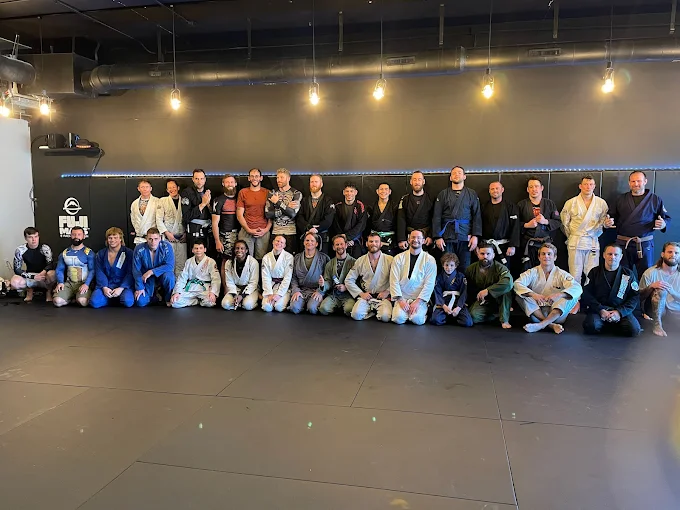
Stress often thrives in isolation. Training changes that because you’re part of a room where everyone is learning, struggling, improving, and laughing at the weird little moments that happen in grappling (there are plenty). The social side isn’t an add-on. It’s a built-in support system.
You’ll work with partners of different sizes and backgrounds, and you’ll learn how to communicate boundaries and goals. That’s healthy. For many adults, it’s also one of the few places in the week where connection feels simple: show up, train, and go home a little lighter.
A 2024 study from the Australian Institute of Sport reported that 92 percent of participants who trained in martial arts at least twice per week reported positive wellness outcomes. Frequency isn’t everything, but consistency does matter. A supportive environment makes consistency realistic.
What to expect in your first month (especially if you’re stressed already)
Starting something new can feel like one more demand. We get it. Our job is to make your first month feel doable, clear, and safe.
Week 1: Learning the language and finding your pace
In the beginning, everything has a name and nothing stays still. You’ll learn basic positions, simple escapes, and how to move without fighting yourself. It’s normal to feel mentally tired after class, and that mental fatigue is often part of the stress relief. Your brain finally had one job.
Week 2: Feeling less lost
You start recognizing patterns. You remember to breathe. You stop trying to “win” every moment and start trying to learn. This shift alone can be a stress breaker because it replaces perfectionism with curiosity.
Week 3: Small wins show up
Maybe you hit a sweep you drilled. Maybe you last longer in a tough position without panicking. These are real milestones. They create evidence that you can stay calm, adapt, and recover.
Week 4: Training starts to feel like part of your week, not a disruption
This is where balance begins. Class becomes a reset button. Many people notice sleep improving, mood stabilizing, and a more even response to everyday annoyances. Not because life got easier, but because you got steadier.
How our classes support stress relief without turning into chaos
Stress relief doesn’t come from going all-out every session. It comes from training with intention. We structure classes so you’re building skills progressively, not just surviving rounds.
Here’s what we emphasize for adults who want wellness and balance:
• Clear instruction and repeatable techniques so your mind can settle into learning instead of guessing
• Controlled intensity options so you can train hard without feeling wrecked afterward
• Partner culture that respects safety, communication, and pacing
• Fundamentals that build confidence quickly, especially in defense and escaping bad positions
• A training rhythm that balances drilling, positional work, and live rounds responsibly
That structure matters because the goal is not to “escape stress” for an hour. The goal is to train your system to handle pressure better everywhere else.
Building a routine that actually reduces stress in Asheville
If you’re trying adult Jiu-Jitsu in Asheville for stress relief, the simplest plan is usually the best plan. Start with a schedule you can keep, then build from there.
A practical approach looks like this:
1. Train two days per week for the first month so your body adapts and your schedule stays sane
2. Add a third day only when you feel recovery and sleep improving, not declining
3. Choose one class each week to focus on slowing down and refining technique
4. Track one or two non-scale wins, like calmer breathing, better sleep, or fewer tension headaches
5. Keep your expectations realistic: progress is steady, not cinematic
This kind of routine lines up with what we see in real life. People who chase intensity often burn out. People who chase consistency usually find the stress relief they’re looking for.
Common concerns we hear from stressed adults (and real answers)
“I’m not in shape yet.”
You don’t need to be. You get in shape by showing up. Jiu-Jitsu meets you where you are because you can scale effort and still learn. The early focus is on movement, safety, and fundamentals.
“I don’t want to get hurt.”
That concern is valid. Safety starts with culture and continues with smart training. We coach control, we prioritize tapping early, and we help you choose appropriate partners as you learn.
“I’m already tired. Will this make it worse?”
In the first week or two, you might feel a new kind of tired. Then many people notice something interesting: training creates better tired. The kind that helps you sleep and recover, not the kind that keeps you buzzing.
“I’m anxious about sparring.”
You’re not alone. Live training is introduced progressively, and you can build comfort step by step. The goal is not to throw you into the deep end. The goal is to help you develop calm under pressure at a pace that’s sustainable.
Jiu-Jitsu as a long-term wellness skill, not a short-term fix
Stress relief is the doorway, but what keeps people training is the deeper benefit: capability. You learn to be comfortable being uncomfortable. You learn that pressure is information, not emergency. Over time, that becomes resilience.
Studies have reported reductions in PTSD symptoms, depression, and anxiety among veterans who train, and broader research points toward improved mental strength and life satisfaction with experience. Again, we’re not presenting Jiu-Jitsu as therapy. But we are saying this: when you practice regularly in a supportive environment, it can become one of the most reliable wellness habits in your week.
And it’s kind of refreshing that the path is straightforward. You show up. You learn. You breathe. You improve. The mats don’t care about your inbox.
Take the Next Step
If you want a practical way to unwind while building skill, Jiu-Jitsu can be the most efficient stress-management tool you haven’t tried yet. We’ve designed our training in Asheville to help you develop confidence, conditioning, and calm, whether you’re brand new or returning after time away.
At Speakeasy Jiu-Jitsu & Wrestling Academy, we keep the experience grounded: smart instruction, a supportive room, and a class structure that helps you leave feeling better than when you walked in, even after a tough round.
Ready to train? Join a Jiu-Jitsu class at Speakeasy Jiu-Jitsu & Wrestling Academy today.