

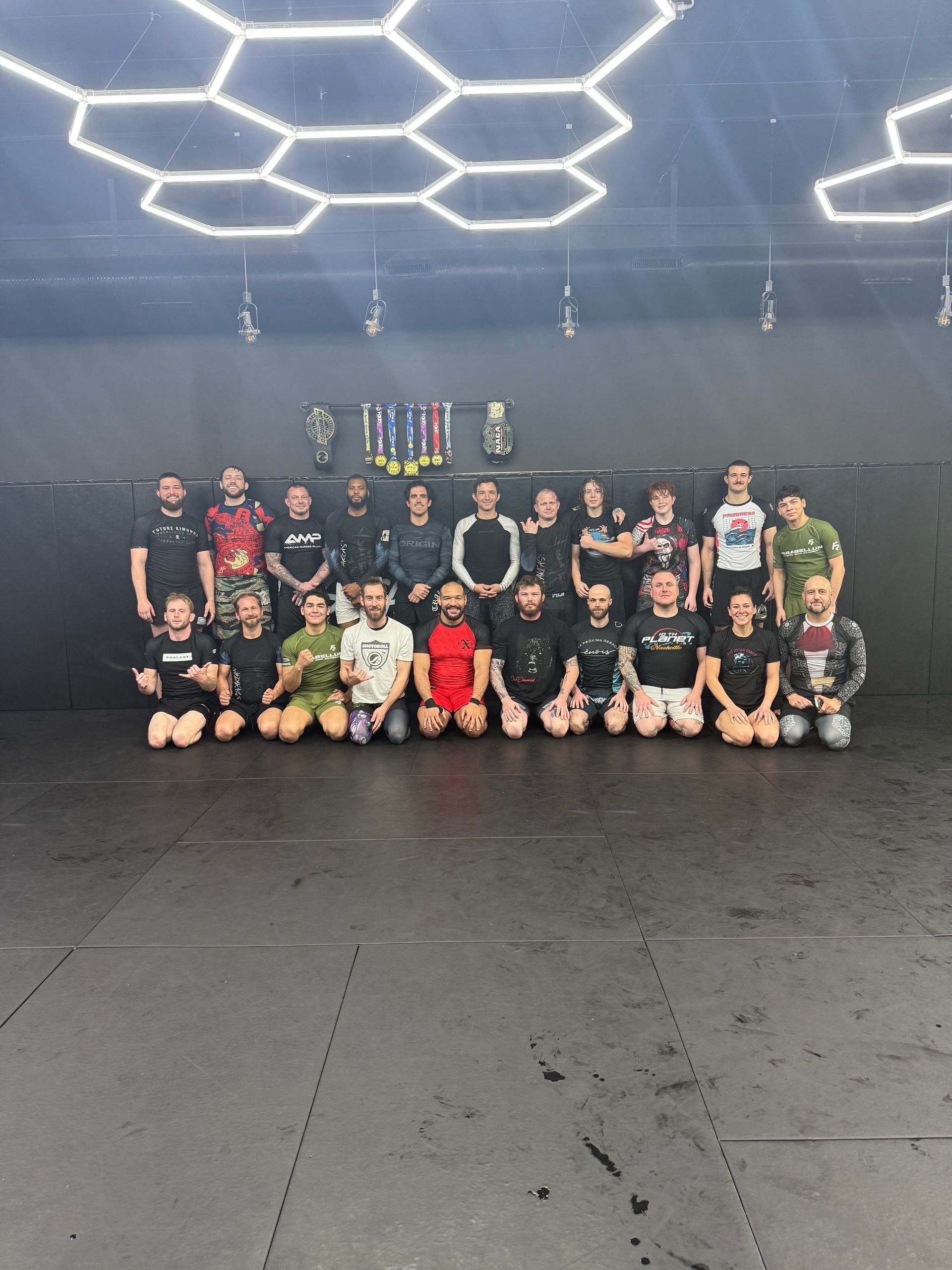
The fastest way to sharpen your mind is to train where pressure is real but progress is always controlled.
If you have ever wished you could stay calmer in stressful moments, focus longer without drifting, or bounce back faster after a setback, Jiu-Jitsu gives you a surprisingly practical training ground for all of it. We do not mean that in a motivational poster kind of way. We mean it literally: you practice problem-solving while someone is actively trying to stop you, and you learn to think anyway.
In Asheville, life can feel like a constant mix of work demands, family schedules, and the pull of an active outdoor culture that is great but still takes energy. Our mats give you a consistent place to build mental toughness and focus with clear structure, helpful coaching, and training partners who keep you honest.
Below, we will break down specific Jiu-Jitsu strategies we use to develop resilience, attention control, and composure under pressure, plus a few simple ways you can carry those skills into your day when you are off the mat.
Why Jiu-Jitsu builds mental toughness differently than motivation ever will
Mental toughness is not a personality trait you either have or do not have. It is a skill set: staying engaged when you are uncomfortable, making decisions with limited time, and continuing to work a plan when the first idea fails. Jiu-Jitsu forces all of that, in small doses, over and over.
Because training is live and unpredictable, you cannot “fake” focus. If your mind wanders, you feel it right away in your timing, your balance, or your ability to defend. That immediate feedback loop is part of why consistent practice builds real resilience, not just hype.
Research trends back this up. Experienced practitioners consistently show higher grit, self-control, self-efficacy, and resilience compared to beginners, and those traits tend to improve with training time. That makes sense: when you practice adapting under pressure every week, you get better at adapting, period.
Focus is a trainable skill and rolling trains it fast
Focus is not just “trying harder.” In Jiu-Jitsu, you practice attention control: noticing what matters, ignoring what does not, and switching gears quickly when the situation changes. Rolling demands full presence because positions shift, grips break, and small mistakes compound.
There is also a neurological angle here. Learning techniques, recalling sequences, and making real-time decisions engages areas of the brain tied to executive function, including the prefrontal cortex. With repetition, you build better pattern recognition and more efficient decision-making. Over time, that can show up in everyday life as better concentration, clearer prioritizing, and less reactivity when something unexpected happens.
We also see a practical benefit for busy adults: the mat is one of the few places you can not multitask. You get a built-in mental reset that is hard to replicate with most workouts.
The core mental toughness loop we train every class
A lot of people assume mental toughness comes from “going hard.” Intensity can help, but only when it is paired with good structure. Our approach uses a loop that repeats in nearly every session:
• Learn a technique with clear details so you know what “good” looks like
• Drill it with increasing resistance so your brain solves timing problems
• Spar with boundaries so you can test ideas without chaos
• Review what happened so you keep the lesson, not just the sweat
That cycle matters because toughness is not only enduring discomfort. It is also staying curious under stress. When you can lose a position, breathe, and rebuild your base instead of panicking, you are practicing a mindset you can take into a rough day at work or a tense conversation at home.
Strategies that build resilience on the mat and carry off the mat
Use constraints to stop overthinking
When you are new, the biggest mental drain is trying to remember everything at once. Constraints solve that. We will often give you a narrow objective, like “hold this position for 20 seconds” or “escape using this one movement pattern.” It is not limiting, it is freeing. Your mind gets to work deeply instead of broadly.
Off the mat, constraints look like choosing one priority for the next hour, not ten. You practice that skill in class, then it shows up when your schedule gets loud.
Train the ability to reset after a mistake
In sparring, mistakes happen quickly. You reach wrong, your posture breaks, you get swept. The key is what happens next. We coach you to reset your breathing, rebuild your frames, and re-enter the exchange with a plan, even if the plan is simple.
That reset skill is a form of emotional regulation. It is also one of the most valuable things adults get from Jiu-Jitsu in Asheville, because daily stress rarely asks permission before it shows up.
Work from “bad positions” on purpose
Mental toughness grows when you learn you can survive discomfort without rushing. Positional sparring from bottom side control, mount, or back control teaches patience and problem-solving under pressure. You learn to make small improvements, not desperate moves.
This is one of the biggest mindset shifts we see: you stop treating adversity as an emergency and start treating it as information.
The role of sparring in composure and clear thinking
Sparring is where mental skills become real. You are not just performing techniques; you are managing adrenaline, pressure, and uncertainty. Done correctly, sparring teaches composure, controlled breathing, and strategic thinking in a way few activities can.
We keep sparring productive by matching intensity appropriately and setting goals for rounds. You might roll with a focus like “protect your posture” or “hunt for the underhook,” so the round becomes a mental drill, not just a physical one.
Over time, that changes how you handle pressure elsewhere. When your heart rate spikes in a meeting or you feel rushed making a decision, you have a familiar internal script: slow down, breathe, find your base, solve one piece at a time.
Our Asheville-specific approach: blending wrestling and Jiu-Jitsu for tougher focus
Asheville attracts people who like to do hard things, but also people who want their training to feel purposeful. We lean into that by integrating stand-up and wrestling concepts with Jiu-Jitsu so your mental toughness is not only about surviving on the ground. You learn how to stay composed during scrambles, hand-fighting, and transitions where things move fast.
Wrestling-style pressure can be mentally demanding because it reduces “rest moments.” That is exactly why it is valuable when taught progressively. You learn to think while moving, maintain discipline in awkward positions, and commit to fundamentals when you are tired.
It also keeps training engaging. Some days the room feels quiet and technical. Other days it is a little more grinding, in a good way. Both develop focus, just through different textures of effort.
A simple framework for better focus during training
If you want a practical way to improve concentration quickly, we recommend using a small checklist during rounds. Keep it simple enough that you can remember it under stress.
1. Breathe low and slow, especially when you feel rushed
2. Protect your posture and base before you chase a submission
3. Solve the position you are in, not the position you wish you were in
4. Make one improvement at a time: frame, hip escape, re-guard, stand
5. After the round, name one thing you did well and one thing to adjust
That kind of reflection is not fluff. It teaches your brain to look for patterns and make clean corrections, which is exactly what focus is.
Stress relief, flow state, and why you feel “lighter” after class
One reason adults stick with Jiu-Jitsu is that the stress relief is hard to ignore. Rolling often creates a flow state where your attention narrows to the present moment. You are not replaying your inbox or tomorrow’s schedule. You are dealing with grips, angles, and timing right now.
Physically, intense training can boost mood-regulating chemicals like endorphins, dopamine, and serotonin. Mentally, the constant problem-solving interrupts rumination. The result is a calmer baseline after class, not because problems disappear, but because your nervous system learns how to downshift.
We also build in a culture where you can train hard without feeling like you have to prove something every round. That matters for stress reduction. When the room feels safe and structured, your brain is more willing to learn.
What beginners can expect in adult Jiu-Jitsu in Asheville
If you are looking for adult Jiu-Jitsu in Asheville, you do not need an athletic background or a competitive personality to benefit. Most adults start because they want a challenging workout, practical self-defense skills, or a consistent routine that improves mental health and confidence.
In your early weeks, the focus is on foundations: posture, frames, escapes, guard retention, and basic submissions taught responsibly. You will also learn how to be a good training partner, which is a skill on its own. That social side, showing up, being coachable, and learning to handle small failures, is part of the mental toughness training.
Expect progress to feel non-linear. You might feel amazing one day and confused the next. That is normal, and it is also the point. You are building patience and persistence, not chasing perfection.
How long it takes to feel the mental benefits
Some benefits show up quickly. Many people notice better stress management and improved sleep within the first few weeks of consistent training. The deeper traits, grit, self-control, and durable confidence, tend to build with time.
Data comparing beginners to advanced belts suggests that long-term training strongly correlates with higher mental strength, resilience, and life satisfaction, and lower rates of certain mental health challenges. We treat that as a reminder to focus on consistency. You do not need to train every day. You do need to train regularly enough that your nervous system keeps learning the lesson.
Take the Next Step
Building a tougher, calmer mind is not about flipping a switch. It is about practicing under the right kind of pressure, with coaching that helps you stay strategic when things get messy. That is exactly what we aim to deliver in every class.
If you want to experience Jiu-Jitsu in Asheville with a program that develops focus, resilience, and real composure, we would love to help you get started at Speakeasy Jiu-Jitsu & Wrestling Academy and build a training routine you can actually sustain.
Train with purpose and see progress on the mat by joining a Jiu-Jitsu class at Speakeasy Jiu-Jitsu & Wrestling Academy.