

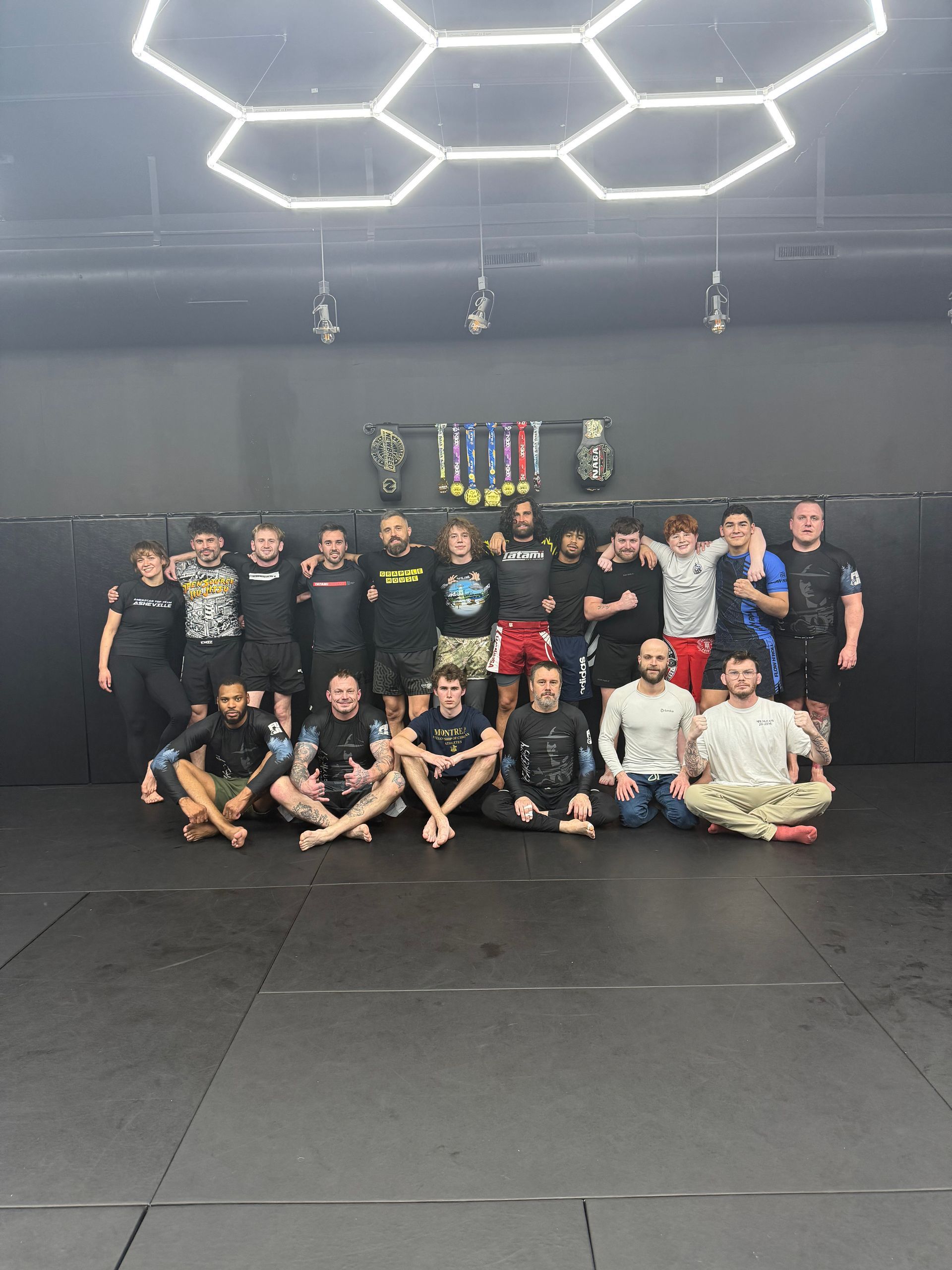
In Asheville, Jiu-Jitsu is one of the quickest ways to build real fitness, sharper focus, and a community you will actually look forward to seeing.
Jiu-Jitsu works because it meets you where you are, then gives you a clear path forward. You do not need to be the fastest, strongest, or most coordinated person in the room to get value on day one. In fact, most people who walk in are simply looking for something that feels engaging again, like exercise with a point.
Here in Asheville, we see the same pattern over and over: people want training that improves health without beating up joints, teaches practical self-defense, and creates real social connection. Jiu-Jitsu fits that perfectly. It is technical, low-impact compared with many contact sports, and built around problem-solving under pressure.
We also love that the growth of Jiu-Jitsu in Asheville is not just a trend. Nationally, Brazilian Jiu-Jitsu schools have expanded steadily for years, and locally we feel that momentum every week on the mats. When training is coached well and progressed responsibly, you can get noticeable gains in conditioning, confidence, and focus faster than you would expect.
Why Jiu-Jitsu clicks so well with Asheville lifestyles
Asheville is packed with people who care about wellness, but also want authenticity. That is why Jiu-Jitsu in Asheville keeps growing: it is challenging without being performative, and it rewards consistency more than raw talent. You can show up tired after work, and still get a great session because the training is skill-based, not ego-based.
Another reason it sticks is variety. A good class includes movement, technique, partner drills, and live rounds. It never feels like mindless reps. You are learning how to control distance, balance, and leverage in real time, and your brain stays switched on the whole session.
We also build training around a simple idea: you should leave class feeling better than when you walked in. Tired, sure. But not wrecked. That approach matters because the goal is progress you can sustain, not a short burst of intensity that burns you out in two weeks.
The fast benefits you will notice first
People sometimes ask what “fast” really means. In our experience, most students notice changes in a matter of weeks, not years, especially if you train consistently and recover well. You might not be tapping out advanced partners anytime soon, but you will feel the shift in your body and mindset.
Here are the early wins we see most often:
• Better cardio without long, boring workouts because live drills naturally push your heart rate
• Stronger core and grip from controlling posture, frames, and pressure in realistic positions
• Improved focus because you have to stay present, breathe, and solve problems under fatigue
• A calmer response to stress since you practice staying composed in uncomfortable spots
• Friendships that form quickly because partners help partners, and effort is easy to respect
Those benefits come from the structure of Jiu-Jitsu itself. You are constantly getting feedback from physics, timing, and positioning. When something works, you know. When it does not, you adjust. That loop builds confidence in a very grounded way.
What a beginner class feels like (and what it is not)
Your first class should feel organized, safe, and welcoming, but still real. We start beginners with fundamentals that keep you protected: posture, base, how to fall safely, how to move on the ground, and how to tap early. If you are nervous about being “thrown in,” you can relax. We coach you through it.
A typical class flow includes a warm-up that actually relates to grappling, technique instruction with details that matter, partner drilling, then controlled sparring options depending on your experience level. We keep the room structured so you know what to do, even if you are brand new and your brain is still trying to remember left from right.
One small sensory detail people mention after their first week: the pace feels different than a normal gym. You are not staring at a timer across a room. You are listening, moving, and working with another person. It is oddly refreshing.
A realistic timeline for progress, belts, and confidence
Belts are not the only measure of progress, but they do provide a helpful timeline. Across the broader Jiu-Jitsu community, survey data from thousands of practitioners shows that average progression from white to blue belt is about 2.3 years, and reaching purple averages around 5.6 years. That is not meant to intimidate you. It is meant to set expectations: this is a skill you build, not a quick certification.
The good news is you do not have to wait years to feel capable. Within two to three months, most consistent beginners can:
• Escape basic holds with more composure
• Recognize common positions like guard, mount, and side control
• Use simple submissions safely, with control and awareness
• Roll without panicking, even when things go wrong
That is the real “fast” transformation. You gain usable competence and a steadier mind, even while you are still learning the bigger system.
Fitness without the high-impact price tag
A lot of people come to us after trying running, bootcamps, or heavy lifting cycles that left them frustrated or banged up. Jiu-Jitsu can be demanding, but it is scalable. You can choose intensity based on sleep, stress, and your body that day, and still make progress.
We also care about longevity. Your joints, neck, and lower back matter. We teach positioning and pressure with control, and we encourage smart training choices, especially early on. If you are training for general fitness and self-defense, you do not need to go full speed every round to improve.
How we help you train hard and stay healthy
Injury risk is real in any contact sport, and Jiu-Jitsu is no exception. A well-known 2019 study found that a majority of athletes reported injuries in a six-month window, and other survey work suggests risk rises with training frequency and belt level. That does not mean you should avoid training. It means you should train with a plan.
Our safety approach is practical and consistent:
1. We teach tapping, posture, and defensive awareness before we push intensity
2. We match partners thoughtfully so size and experience do not create avoidable problems
3. We keep technique sharp and controlled, because sloppy speed causes most issues
4. We encourage recovery habits like hydration, sleep, and taking rest days seriously
5. We guide competition readiness progressively instead of rushing beginners into it
If you have past injuries or limitations, we can usually modify training so you can still participate. Jiu-Jitsu is adaptable when coaching is attentive.
Self-defense that is pressure-tested, not theoretical
Self-defense is a common reason people start Jiu-Jitsu in Asheville, and it makes sense. Jiu-Jitsu emphasizes leverage, control, and escapes from bad positions. It is not built on perfect conditions. You learn how to manage distance, maintain balance, and keep thinking when someone is resisting.
We teach self-defense concepts through real positions, not just scripted sequences. That matters because the moment you feel resistance, you learn what you can actually rely on. Over time, you build a toolkit of high-percentage movements that hold up under pressure.
Just as important, you gain situational awareness and confidence. When you have trained to stay calm in uncomfortable situations, everyday stress feels different. You do not become reckless. You become steadier.
Kids Jiu-Jitsu in Asheville: confidence, structure, and better choices
Kids Jiu-Jitsu in Asheville has become one of the most popular ways for families to support confidence and resilience without putting kids into a constant collision sport. Our kids program focuses on discipline, listening skills, safe physical play, and learning how to handle conflict appropriately.
For many kids, the biggest change is not physical at all. It is behavioral. When kids practice taking instruction, working with partners, and resetting after mistakes, those habits show up at school and at home. We keep classes structured, upbeat, and clear, so kids know what is expected.
Parents also appreciate that Jiu-Jitsu gives kids a positive outlet. After class, kids are often happily tired, the good kind of tired, and more regulated. It is not magic, but it is a reliable pattern.
What your child learns on the mat
We teach skills that build confidence without promoting aggression:
• Body awareness and balance, so kids move safely and with control
• Respectful partner work, including taking turns and following rules
• Simple escapes and boundary-setting, framed around safety and responsibility
• Emotional control, like breathing, pausing, and trying again after losing a position
• Goal-setting through stripes, attendance habits, and gradual skill milestones
We also communicate clearly with parents about pacing and readiness. Kids develop at different speeds, and that is normal.
Wrestling integration: a practical edge for real grappling
One thing that accelerates learning is understanding how to control where the fight happens. Wrestling concepts like stance, level change, and takedown fundamentals blend naturally with Jiu-Jitsu. When you can stay balanced on your feet and finish a clean takedown, your whole game opens up.
We integrate wrestling in a way that supports Jiu-Jitsu goals, not replaces them. You learn how to enter safely, how to protect your posture, and how to transition into control on the ground. It is not about smashing. It is about building complete grappling skill.
For adults, that can mean better conditioning and confidence in scrambles. For teens, it can mean a healthy competitive outlet. For kids, it often shows up as improved coordination and body control.
Community and friendships that form quickly
The social side of Jiu-Jitsu is not an extra. It is part of why people stay. Training partners see you struggle, improve, and keep showing up. That shared effort builds trust quickly, and it makes the gym feel like a place you belong, even if you are new.
We also keep a culture where questions are normal. If you forgot the steps, if you are confused about a grip, if you want to slow down and rep it again, that is fine. Progress comes from curiosity and consistency.
And yes, you will laugh sometimes. Not in a silly way, but in the way people do when they realize they are learning something hard and enjoying it more than expected.
Getting started in Jiu-Jitsu in Asheville without overthinking it
Starting is usually the hardest part because you think you need to prepare. You do not. You need comfortable workout clothes, basic hygiene, and a willingness to learn.
If you are brand new, here is what we recommend:
• Show up a little early so you can settle in and ask questions
• Focus on safety first: tap early, breathe, and move with control
• Train two to three times per week if your schedule allows, then adjust
• Expect to feel awkward at first, because everyone does
• Track small wins like better posture, smoother movement, and calmer breathing
Consistency beats intensity. If you train steadily, you will feel the difference in your body and mindset faster than you think.
Ready to Begin
If you want Jiu-Jitsu that builds fitness, focus, and real friendships without the usual gym burnout, we would love to help you start. Our classes are structured for beginners, challenging for experienced students, and paced for long-term progress.
We built everything at Speakeasy Jiu-Jitsu & Wrestling Academy around safe coaching, clear fundamentals, and a community that makes it easy to keep showing up. If you are looking for kids Jiu-Jitsu in Asheville, adult training, or a blend that includes wrestling, we will help you find the right fit on the mat.
Train with experienced instructors and a supportive team by joining a Jiu-Jitsu class at Speakeasy Jiu-Jitsu & Wrestling Academy.