

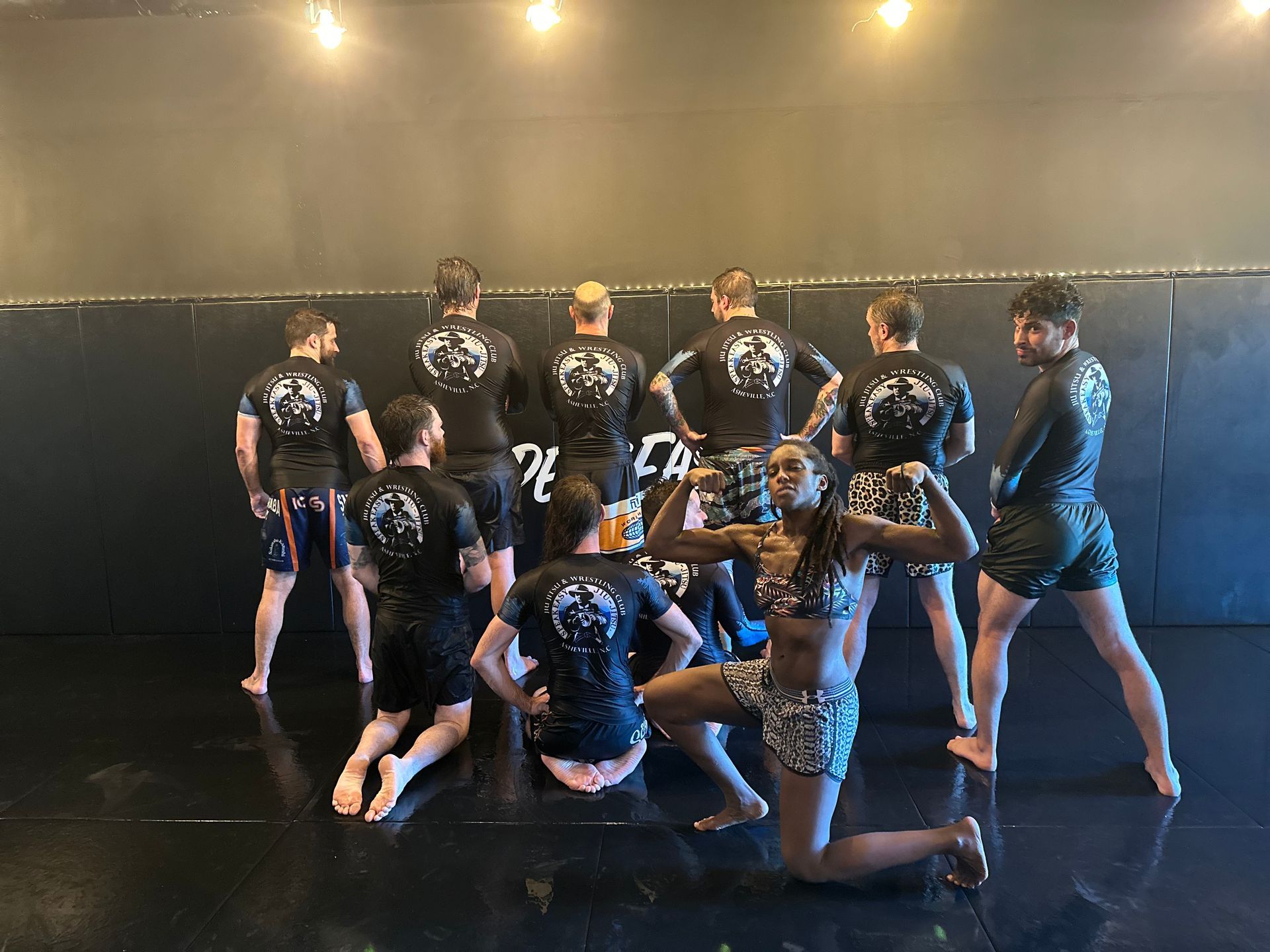
Resilience is not something you either have or do not have, it is something we train one steady round at a time.
If you are looking at Jiu-Jitsu in Asheville, there is a good chance you want more than a workout. You want something that makes you feel capable under pressure, stronger in your body, and clearer in your head. We see that goal every day, especially with adults balancing work, family, and the general noise of life.
Jiu-Jitsu is practical in a way that surprises people. It is not just learning moves, it is learning how to keep thinking while your heart rate climbs, how to stay calm in uncomfortable positions, and how to try again after a mistake without spiraling. That is resilience, and it carries over.
Asheville is an active, wellness-oriented city, and that culture fits Jiu-Jitsu really well. Our approach is technique-first, progressive, and built for real people, not just lifelong athletes, so you can start where you are and build from there.
What resilience really looks like in Jiu-Jitsu
Resilience is often described like a personality trait, but on the mat it becomes a set of behaviors you practice. You learn to breathe when you want to panic. You learn to problem-solve when you are pinned. You learn to accept that improvement is not linear, and that you can still show up and get better.
In training, discomfort is controlled and purposeful. That matters. You are not being thrown into chaos with no structure. You are learning to handle pressure in a safe environment, with coaches guiding you and partners working with you, not against you. Over time, your nervous system adapts. Your body learns what effort feels like. Your mind learns that a bad moment is not the end of the story.
One of the most useful lessons is how quickly things change. You can be in a tough spot, make one small adjustment, and suddenly you are safe again. That teaches a quiet kind of optimism: if you keep working, the situation can improve.
Why Jiu-Jitsu builds mental toughness faster than most workouts
Most fitness routines are about pushing through discomfort, but they do not always demand decision-making under stress. Jiu-Jitsu does. You are constantly collecting information: where your balance is, what grips you have, how your opponent is shifting, what the next safe step is.
That process builds mental toughness without you needing to psych yourself up. You simply get reps. You learn how to reset after you tap. You learn how to take feedback, try it immediately, and see what happens. That loop of effort, feedback, and adjustment is basically a resilience engine.
It also teaches patience. National averages for belt progression reflect that reality: many practitioners take about 2.3 years from white belt to blue, and around 5.6 years to purple. That timeline is not a drawback, it is a feature. You are building something durable. Showing up consistently for months is its own kind of toughness.
Physical resilience: strength, mobility, and staying in the game
A lot of adults worry that starting a martial art will be hard on the body. We get it. The good news is that Jiu-Jitsu can be trained in a way that is challenging but not reckless. It is often described as lower-impact than striking sports, and it rewards leverage, positioning, and timing more than brute force.
Physical resilience is not just being strong. It is being able to move well, recover well, and train consistently. When you train regularly, you build stronger connective tissue, better joint control, and a more reliable gas tank. You also learn to recognize the difference between productive discomfort and the kind you should not ignore.
We coach you to build your base first. That means learning how to fall safely, how to frame and protect yourself, how to use your hips, and how to escape bad positions without panicking. Those fundamentals are protective.
Wrestling integration: a different kind of resilience
Our program blends grappling styles in a way that gives you more tools and more confidence, and wrestling is a big part of that. Wrestling develops pressure, balance, and an ability to keep working through transitions. It also teaches you to commit to positions, recover when a scramble does not go your way, and stay composed when the pace rises.
That matters for adults. Life is not always slow and controlled. Sometimes it is fast and messy, and wrestling-style movement helps you stay functional in those moments. You learn how to get up, how to keep posture, how to drive through your legs, and how to use your whole body as one connected system.
When wrestling and Jiu-Jitsu come together, resilience shows up in a simple way: you stop feeling stuck. Whether you are standing, clinched, or on the ground, you have options.
The role of community in resilience (and why it is not just feel-good talk)
Resilience is easier to build when you are not doing it alone. One of the underrated parts of Jiu-Jitsu in Asheville is the social structure that forms naturally in consistent training. You see the same people week after week. You learn each other’s styles. You celebrate small wins. You notice when someone is improving, even before they notice it themselves.
Training partners also keep you honest, in a good way. You cannot fake progress. But you also do not have to be perfect. You can show up tired, have a rough day, and still get meaningful work in. That balance of accountability and support is rare.
And yes, some days the best part is just walking out feeling lighter than when you walked in. Not every class needs to be heroic. Some classes are just steady. That is still resilience.
What adult Jiu-Jitsu in Asheville looks like when you are new
If you have never trained before, your first few classes will probably feel like learning a new language. That is normal. We structure classes so you get a clear theme, a technique or two, and then you practice with increasing realism. You are not expected to know what you are doing on day one.
Adult beginners often worry about three things: being out of shape, being too old, or being the only new person. The truth is that adult Jiu-Jitsu in Asheville attracts a wide mix of people. Some are athletic. Some are returning to fitness after years. Some are dealing with stiff hips and desk posture and are just trying to feel better. We plan for that variety.
Your job at the start is simple: learn to tap early, breathe, and focus on one improvement at a time. A month in, you will move better. A few months in, you will recognize positions. Over time, you will start solving problems instead of just surviving them. That shift is huge.
A simple resilience framework we teach on the mat
Resilience can feel abstract, so we like to make it concrete. Here is the pattern you practice in live rounds, whether you realize it or not:
1. Notice you are under pressure and name the problem (stuck, pinned, off-balance)
2. Stabilize first by breathing and protecting yourself before you try to escape
3. Make one small technical change instead of ten frantic ones
4. Accept the tap or the reset as information, not as failure
5. Repeat with a slightly better plan next round
That is exactly how resilient people handle stress at work, setbacks in relationships, or hard seasons in life. You do not skip the hard part. You learn to move through it with more skill.
Competition and pressure testing: why it changes you
Not everyone wants to compete, and you do not have to. But having the option matters, because it gives you a clear way to pressure test your skills. Preparing for a tournament teaches you how to manage nerves, stick to a plan, and perform even when you feel uncomfortable.
Competition also gives you a clean lesson in outcome control: you can do everything right and still lose. You can make a mistake and still come back. That is resilience in its purest form. It teaches you to focus on preparation and process, not just results.
The data around injury risk is also worth talking about openly. Studies show injury likelihood can rise as experience increases, and competition can be riskier for advanced athletes. That is why we keep training progressive and structured, and why we emphasize smart intensity. You can train hard without training reckless, and that approach supports long-term resilience.
Safety, longevity, and training smart
Resilience includes knowing when to push and when to pull back. We build safety into the culture: tapping early, communicating with partners, and choosing the right intensity for the day. You will hear us talk about positioning, control, and awareness as much as submissions, because those are what keep you training for years.
We also encourage you to treat recovery as part of training. Sleep, hydration, mobility work, and showing up consistently beat occasional all-out sessions. If you are the kind of person who tends to go too hard too fast, we will guide you into a pace that keeps you improving.
A good academy should make you more capable, not more broken. Our goal is sustainable training that still challenges you.
Off-the-mat benefits you can actually notice
The confidence you gain from Jiu-Jitsu is not loud. It is practical. You start trusting yourself in stressful moments because you have been there before, in a controlled way, on the mat. You learn to stay calm when things are tight. You learn to keep working when you feel behind.
Common changes students tell us they notice include:
• Better stress management because your body learns to downshift after intensity
• More patience in daily life because progress in Jiu-Jitsu is earned slowly
• Stronger boundaries and self-advocacy because you practice consent and control
• Improved focus because you have to be present during rounds
• A healthier relationship with failure because tapping becomes normal and useful
That is the kind of resilience that shows up everywhere: in meetings, in parenting, in deadlines, in setbacks you did not plan for.
Start Your Journey
Training with purpose changes how you handle pressure, and that is what we build every day at Speakeasy Jiu-Jitsu & Wrestling Academy. When you commit to Jiu-Jitsu, you are not just learning techniques, you are practicing calm problem-solving in real time, with coaching, structure, and a community that keeps you moving forward.
If you want Jiu-Jitsu in Asheville that supports both performance and longevity, we will help you start smart, train safely, and progress at a pace you can sustain. Whether your goal is fitness, self-defense, competition, or simply feeling more resilient in daily life, we are ready when you are.
Take what you learned here to the mat by joining a Jiu-Jitsu class at Speakeasy Jiu-Jitsu & Wrestling Academy.