

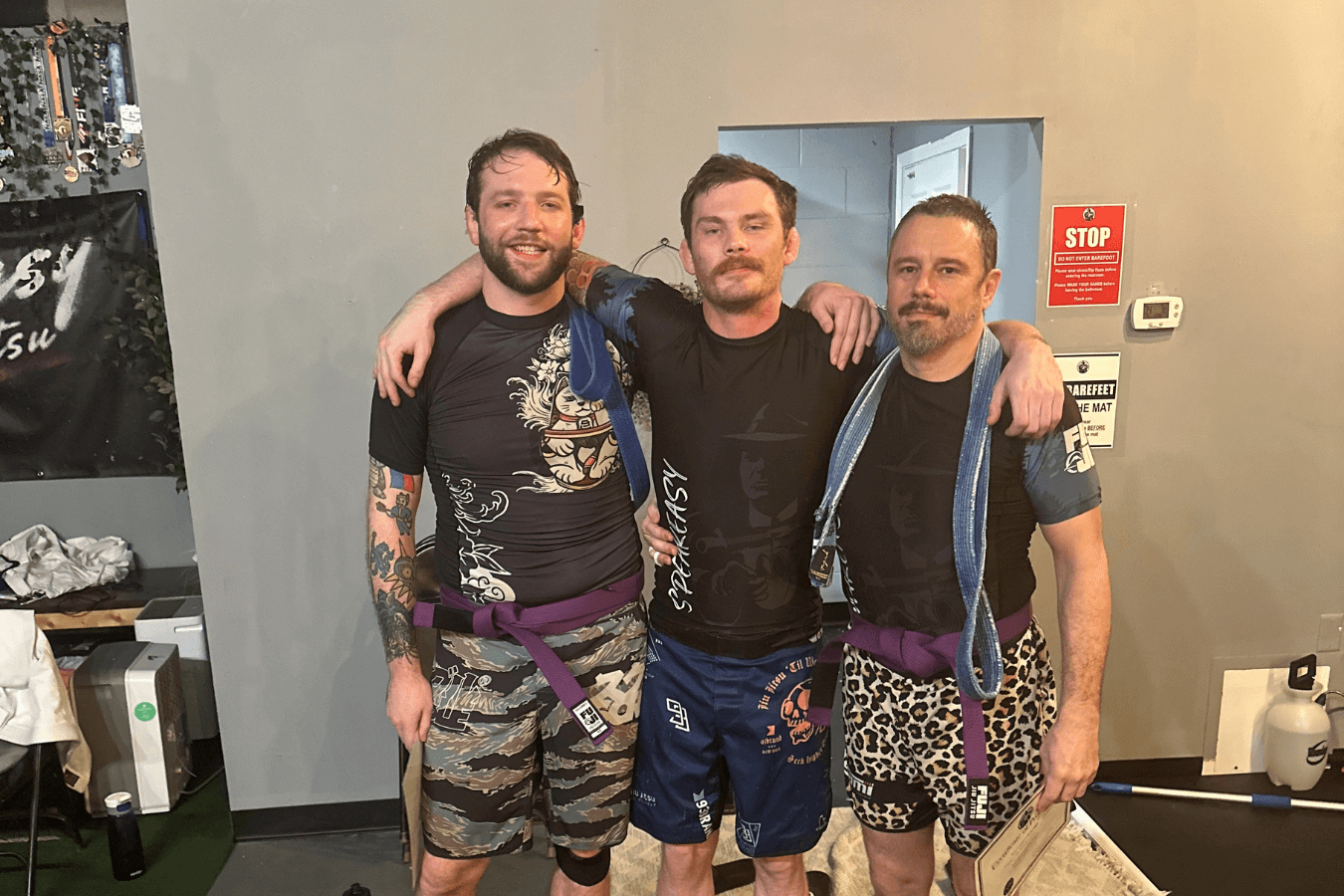
Jiu-Jitsu gives you a repeatable way to feel sharper, move better, and stay calm under pressure, even on busy Asheville weeks.
Most people don’t actually need another fitness trend. You need something you can show up to when work is heavy, your sleep is a little off, and motivation is inconsistent. That’s one reason Jiu-Jitsu works so well for so many Asheville locals: it’s structured, engaging, and mentally active in a way treadmill miles rarely are.
In our academy, we see a clear pattern. When you train consistently, your energy stops feeling random. Your focus improves because the training demands it. And your resilience grows because you practice solving problems under pressure, safely, with guidance, and with teammates who want you to get better.
This article breaks down how Jiu-Jitsu in Asheville supports your day-to-day performance, not just what happens on the mats. We’ll also cover what training looks like for adults and kids, how we build skills progressively, and how our blend of grappling and wrestling creates a very practical kind of fitness.
Why Jiu-Jitsu Feels Different From Regular Workouts
A standard gym session can be productive, but it’s often passive: headphones on, reps done, go home. Jiu-Jitsu is interactive. You’re constantly reading balance, timing, grips, and distance. Because your partner moves unpredictably, you can’t fully check out mentally, which is exactly why the training carries over into real life.
There’s also a unique “freshness” to the work. Even when we repeat the same fundamentals, each round feels different because each body is different. You’ll problem-solve in real time, and your brain starts to associate exertion with curiosity instead of dread. That shift alone can change how your energy feels throughout the week.
And yes, the physical benefits are real: better conditioning, strength endurance, mobility, and coordination. But the bigger win for many students is the way training organizes your attention. You don’t just burn calories. You practice staying present.
Energy: How Training Builds Stamina You Actually Notice
“More energy” can sound vague, so we like to define it as capacity: the ability to do what you need to do without feeling drained all the time. Jiu-Jitsu builds that capacity through intervals of effort and recovery that mimic real life. You work, you breathe, you reset, you work again.
Conditioning Without the Boredom Factor
Rolling and drilling create natural intensity changes. Some moments are explosive, others are controlled and technical. That variety trains your cardiovascular system, but it also teaches you how to recover while still moving. In daily life, that looks like climbing stairs without getting winded, carrying groceries without feeling cooked, or keeping up on a long hike without needing ten breaks.
Because Asheville has such a strong outdoor culture, we see Jiu-Jitsu complement hiking, cycling, trail running, and climbing especially well. Training strengthens hips, core, and grip in a way that tends to make outdoor movement feel more stable and confident.
Strength That Shows Up in Real Positions
Jiu-Jitsu doesn’t build strength in a vacuum. You learn to generate force while being folded, pulled, or pinned, which is a very different skill than lifting with perfect form and perfect conditions. You develop strong legs for base, a durable core for posture, and shoulders that learn how to stabilize.
We also integrate wrestling concepts, which adds another layer of athleticism: pressure, stance, movement, and balance. Many students notice their “everyday strength” improving first, before any mirror changes happen.
Focus: Why Grappling Improves Attention and Decision-Making
A lot of people come to Jiu-Jitsu for fitness and stay because it clears their head. On the mats, multitasking doesn’t work. If your mind drifts, you get swept, pinned, or submitted, and the feedback is immediate. That’s not harsh. It’s actually helpful, because it trains focus like a skill you can practice.
The Problem-Solving Loop That Builds Mental Sharpness
During sparring, you’re constantly asking and answering questions with movement:
• Where is my balance right now, and what’s my base?
• What grips matter, and which grips are distractions?
• What’s the safest next step with the least energy cost?
• If I’m stuck, what’s one small improvement I can make?
That loop is the same process you use when your day gets chaotic: pause, assess, choose the next best action, and commit. Over time, you get quicker at making decisions without panicking.
Flow State, Without Needing Perfect Conditions
There’s a reason people leave class looking tired but calmer. Jiu-Jitsu pushes you into a focused state where your attention narrows to what matters: frames, angles, breath, timing. You can’t scroll your way into that feeling. You have to earn it with real effort and real presence.
If you work a job that demands constant thinking, this is surprisingly restorative. You’re still using your brain, but in a different channel, one that feels clean and direct.
Everyday Resilience: Training Calm Under Pressure
Resilience isn’t just toughness. It’s the ability to stay effective when things get uncomfortable. Jiu-Jitsu trains that directly. You spend time in disadvantage, you learn how to breathe, you escape, and you reset. You learn that “stuck” is often just a temporary position, not a permanent situation.
Getting Comfortable Being Uncomfortable, Safely
We keep training controlled and progressive, especially for beginners. The goal isn’t to overwhelm you. The goal is to introduce pressure in manageable doses so you can adapt. You’ll learn how to protect yourself, how to tap early, and how to communicate with partners. That creates the conditions for real growth without needless risk.
Resilience also shows up socially. Training partners come from different backgrounds, but the mats tend to flatten status quickly. When you’re drilling, you’re just two people trying to improve. That shared effort builds genuine connection, and connection is part of resilience too.
Confidence That Comes From Evidence
Confidence is often misunderstood as hype. What we see instead is evidence-based confidence: you practice something, you improve, you pressure test it, and you trust it more. That trust spills into daily life. Students tell us they handle conflict better, speak up more clearly, and feel less rattled by minor stressors. Not because life becomes easier, but because your response becomes steadier.
What Adult Jiu-Jitsu in Asheville Looks Like in Real Life
Adult training has to fit real schedules and real bodies. We coach adults who are brand new, adults who trained years ago, and adults who cross-train for other sports. Our job is to meet you where you are and give you a pathway that makes sense.
For many people, adult Jiu-Jitsu in Asheville becomes the anchor habit of the week. You show up, you move, you sweat, you learn, and you leave with a clear head. If you’re the kind of person who does better with structure, classes can be the difference between “I should work out” and “I did the work.”
A Progressive Learning Path (So You Don’t Feel Lost)
We teach fundamentals in a way that stacks. You learn position before submission, escape before attack, and posture before speed. That order matters because it reduces frustration and keeps you safer. And we repeat key concepts on purpose, because skill is built through reps, not inspiration.
Here are a few things we focus on early so you can feel progress quickly without rushing:
• How to fall, frame, and protect yourself when pressure increases
• How to move your hips and recover guard without burning out
• How to maintain top control with balance instead of squeezing
• How to escape common pins using timing and leverage
• How to spar in a controlled way that supports learning
How Kids Jiu-Jitsu in Asheville Supports Focus and Confidence
Kids don’t need another activity that just drains energy. You want something that channels energy into listening, coordination, and self-control. Kids Jiu-Jitsu in Asheville does that well because it’s physical, but it’s also structured. Kids learn to follow directions, take turns, and keep trying when something feels tricky.
We keep the environment supportive and disciplined, with clear expectations. Over time, many parents notice improvements that show up at home and school: better patience, more body awareness, and a healthier relationship with challenge.
Skills That Transfer Beyond the Mats
Kids practice resilience in small, repeatable moments: getting pinned lightly, working an escape, trying again. That teaches persistence without lectures. They also learn respect and cooperation because progress requires partners. Nobody gets good alone.
And because Jiu-Jitsu is built on leverage, kids can succeed through technique instead of size. That’s huge for confidence, especially for kids who don’t always feel like the biggest or loudest in the room.
Wrestling Integration: Why It Matters for Energy and Practical Control
Pure ground work is valuable, but in real grappling, transitions matter. Wrestling concepts tighten the whole system: stance, movement, takedowns, and the ability to stay balanced when someone is pushing into you. That blend is a major part of our approach because it supports functional athleticism.
From an energy perspective, wrestling-style movement builds strong legs and lungs fast. From a focus perspective, it demands commitment to position and pressure. From a resilience perspective, it teaches you to keep working when you’re not in your favorite spot.
If you like measurable improvement, this blend is satisfying. Small technical upgrades make a big difference quickly: better posture, better base, cleaner entries, smoother control.
How to Start Without Overthinking It
You don’t need to “get in shape first.” We coach beginners all the time, and we adjust intensity so you can learn safely. The most important step is simply getting on the mats and letting consistency do its job.
Here’s a simple way to begin that keeps things low-pressure and practical:
1. Check the class schedule on the website and pick a realistic training time
2. Show up a little early so we can get you oriented and answer questions
3. Train at a pace where you can learn, breathe, and stay safe
4. Focus on positions and escapes first, not fancy techniques
5. Build momentum with a routine you can actually maintain
Take the Next Step
If you want more energy that feels steady, focus that carries into work and home, and resilience you can rely on, Jiu-Jitsu is one of the most direct ways to train those outcomes. The combination of technical learning, live problem-solving, and supportive structure makes it more than a workout, and Asheville is a great place to commit to that kind of practice.
We’ve built our programs at Speakeasy Jiu-Jitsu & Wrestling Academy to make progress feel clear and sustainable, whether you’re exploring adult Jiu-Jitsu in Asheville, looking for kids Jiu-Jitsu in Asheville, or simply ready to experience Jiu-Jitsu in Asheville with a coaching team that cares about fundamentals and long-term development.
Develop stronger fundamentals and take your training to the next level by joining a Jiu-Jitsu class at Speakeasy Jiu-Jitsu & Wrestling Academy.