

Jiu-Jitsu gives your mind a break by asking your body to pay attention, right now, in the best possible way.
Asheville is an easy place to love and a surprisingly easy place to burn out. Between packed weekends, service industry hustle, remote-work blur, and the pressure to keep up with an outdoor lifestyle, stress can stack up quietly. We see it all the time: people who are doing fine on paper, but feel mentally noisy and physically tense.
Jiu-Jitsu is one of the most reliable stress relievers we’ve found because it works on multiple levels at once. You get hard exercise, real problem-solving, and a room full of training partners who want you to improve. That combination is rare, and it’s exactly why so many people stick with it even when life gets busy.
Research backs up what our mats show every week. In surveys of Brazilian Jiu-Jitsu practitioners, 87.5 percent report reduced anxiety, 96.9 percent report improved mood, 87.6 percent report improved confidence, and 100 percent report a strong sense of community. Those numbers matter because stress is not just physical, it’s chemical, cognitive, and social all at the same time.
Why stress feels different in Asheville
Stress isn’t only about a heavy workload. It’s also about unpredictability, isolation, and the feeling that you’re always “on.” Asheville has a mix that can amplify all three: seasonal rushes, high expectations in hospitality and healthcare, and a lot of people living far from family support systems.
Even the good stuff can become pressure. If you love hiking, climbing, or paddling, it’s easy to feel like you should always be outside, always training, always maximizing the day. When your nervous system never gets a true downshift, rest starts to feel like a chore instead of recovery.
That’s where Jiu-Jitsu fits Asheville so well. It’s indoor training with a clear structure, a coach-led hour that asks you to focus on what’s directly in front of you. For many students, it becomes the most dependable “off switch” in the week.
What makes Jiu-Jitsu such an effective stress reliever
Most stress management advice focuses on removing stressors. That’s useful, but it’s not always realistic. Jiu-Jitsu helps by changing how your body responds to stress and how your mind interprets pressure, even when you can’t control the day.
It lowers stress chemistry through hard, safe exertion
During training, your body does real work. That physical exertion releases endorphins, and over time it can help lower baseline stress hormones like cortisol and reduce the constant surge of adrenaline that makes people feel wired and tired at the same time.
You don’t have to train like an athlete to get this effect. A beginner-level class done at a sustainable pace is still enough to shift your mood. Many students notice it the first week: you walk in carrying tension, and you leave feeling lighter, almost quieter.
It turns your attention into a skill, not a struggle
Stress often feels like mental multitasking you didn’t sign up for. Jiu-Jitsu strips that away. When you’re learning to frame properly, control distance, or escape a pin, your brain can’t keep running yesterday’s argument or tomorrow’s deadlines at full volume.
That’s mindfulness with teeth, for lack of a better phrase. You’re present because the task requires it, not because you’re forcing yourself to “be present.” It’s a practical kind of focus that transfers surprisingly well to work and family life.
It builds confidence the honest way
Confidence that comes from repeating hard things is different than hype. In Jiu-Jitsu you solve problems with feedback in real time. You try a technique, it works or it doesn’t, you adjust, and you try again. Over weeks and months, that becomes a personal history of “I can handle this.”
The data lines up here too: 87.6 percent of practitioners report improved confidence. That confidence is a stress buffer. When you trust your ability to respond, daily life stops feeling like a series of emergencies.
The “pressure practice” effect: resilience you can feel
One reason Jiu-Jitsu in Asheville keeps growing is that the training gives you controlled adversity. You experience pressure in a supervised setting, with clear boundaries and partners who are learning too. That’s not chaos. It’s practice.
Over time, we see students get better at staying calm while their heart rate is up. That matters, because stress in real life often shows up as elevated heart rate plus uncertainty. The mat teaches you to breathe, make small decisions, and keep moving even when you’re uncomfortable.
Recent research trends from 2021 to 2025 describe Jiu-Jitsu and martial arts more broadly as promising mental health interventions, with calls for more long-term studies on training frequency, rank, resilience, and grit. A 2024 finding across martial arts training reported that 92 percent of trainees practicing twice weekly reported mental health gains. In our experience, that twice-a-week rhythm is where many people start to feel steady change, not just a temporary boost.
Community is not optional for stress relief
Stress thrives in isolation. One of the most overlooked benefits of Jiu-Jitsu is that it gives you a consistent social environment with shared effort. You show up, you learn names, you drill with partners, you laugh at the awkward moments, and you get a little better together.
Studies reflect this in a way that’s almost blunt: 100 percent of surveyed practitioners reported a strong sense of community. That’s not a small detail. Community reduces stress because it lowers the sense of carrying everything alone.
And in Asheville, community matters. People move here for beauty and lifestyle, but that doesn’t automatically create belonging. Training partners and coaches can become your weekly anchor, which is a big deal when life feels scattered.
What a typical class feels like when you’re stressed
A lot of people delay starting because they imagine they need to get in shape first or “be less anxious” before they try something new. We understand that hesitation. The truth is that the training itself is what starts changing your stress response.
A typical class structure keeps things simple and predictable. You’ll warm up, learn a technique or two, drill with a partner, and then add resistance gradually as you build comfort. You’re not thrown into the deep end on day one, and you’re not expected to know what you’re doing immediately. Nobody does.
You also get something stressed brains love: a clear next step. Instead of vague self-improvement goals, you get “today we’re working on posture in guard” or “today we’re practicing a side control escape.” Small wins accumulate fast.
Stress relief for high pressure jobs and high responsibility lives
Some Asheville residents carry stress that doesn’t turn off at 5 pm. Healthcare workers, first responders, teachers, managers, and parents often need a method that works even when sleep is imperfect and life is loud.
Research has explored Jiu-Jitsu’s benefits for PTSD, depression, and emotional regulation, including in veterans and first responders, with evidence suggesting durable improvements over time. We can’t promise any single outcome for every person, but we can say this: the training environment is built around learning to make decisions under pressure, and that skill maps closely to demanding jobs.
It’s also a place where you get to be a student again. That sounds small, but it’s not. When your identity is “the responsible one,” having a space to learn, fail safely, and improve is deeply restorative.
Kids and stress: why early training matters
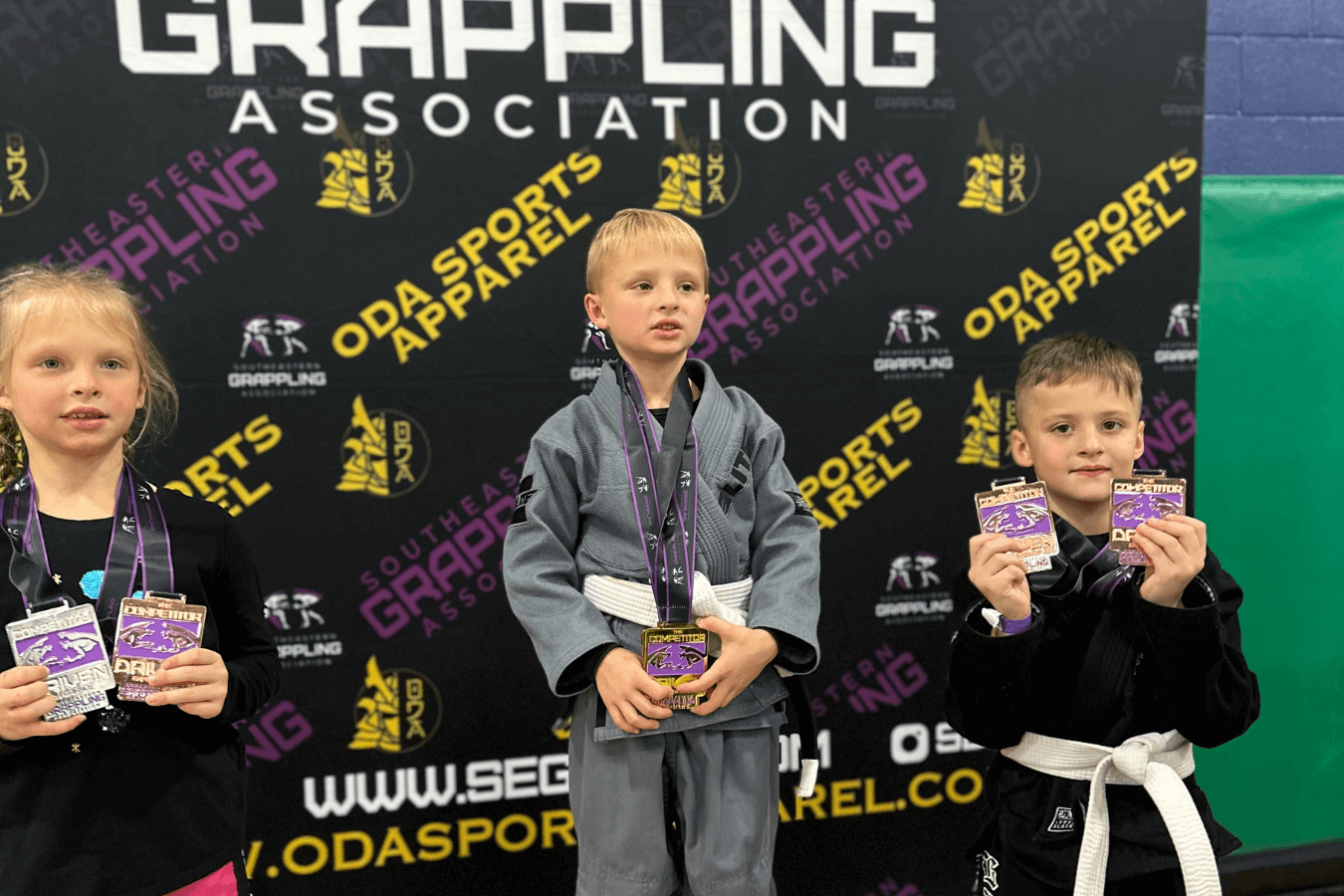
Adult stress is obvious. Kids’ stress can be quieter, and it often shows up as frustration, avoidance, or big emotional swings. That’s one reason kids Jiu-Jitsu in Asheville has become such a meaningful option for families who want something beyond screens and scattered schedules.
Jiu-Jitsu gives kids a structured outlet for energy and emotion. It teaches body control, listening skills, and how to stay calm while solving a problem. The physical part helps, but the real win is emotional regulation: learning that discomfort is temporary and that effort changes outcomes.
Parents often tell us the benefits show up at home first. Kids start using better self-control when they’re upset, and they recover faster after frustration. Research trends support this general direction, noting improvements in aggression mitigation, resilience, and life skills transfer to real-world situations. If you’re looking for kids Jiu-Jitsu in Asheville that builds both confidence and composure, this is exactly the lane Jiu-Jitsu lives in.
How often to train for mental health benefits
Consistency beats intensity for stress relief. If you train once in a while, you’ll still enjoy it, but the deeper nervous-system change tends to come from repetition. Based on current research trends and what we see in our classes, twice weekly is a strong starting point for most people.
If you can do three days some weeks, great, but we also respect real schedules. The point is to make training a predictable appointment with yourself, like brushing your teeth for your brain.
Here’s a simple approach we recommend for many beginners:
1. Train twice per week for the first month to build familiarity and reduce intimidation.
2. Add a third session only if your recovery and schedule feel stable.
3. Keep at least one rest day between harder sessions while your body adapts.
4. Track mood and sleep quality, not just technique progress.
5. Adjust pace in class as needed, because sustainability is the goal.
Why Jiu-Jitsu works even if you’re not “athletic”
One of the best things about Jiu-Jitsu is that it scales. Bigger, smaller, younger, older, more athletic, less athletic, it all fits because technique and timing matter. We coach you to use leverage, position, and smart movement instead of raw force.
That matters for stress relief because the last thing you need is a program that makes you feel behind. You should feel challenged, yes, but also supported. Training should meet you where you are and still give you a path forward.
And if you’re worried about injuries, we get it. A good academy culture emphasizes tapping early, learning control, and building skills gradually. Stress relief only works when you feel safe enough to relax into learning.
What you can expect to notice in a few weeks
The first benefits are usually the simplest: better mood after class, improved sleep, and less mental chatter. Many practitioners report quick gains in mood and confidence, and the research reflects that trend. Over time, the changes become more durable: improved patience, better boundaries, and a calmer baseline.
We also see people become more resilient in everyday friction. Traffic, long lines, tense conversations, annoying emails, these things still exist, but they don’t hook you as easily. You’ve practiced staying calm when someone is applying pressure, literally, so normal stressors start to feel more manageable.
If you’ve been searching for Jiu-Jitsu in Asheville as a way to get in shape, you’ll get that too, but we find most students stay because the training improves how life feels between workouts.
Take the Next Step
If you want a stress reliever that’s physical, skill-based, and genuinely social, we’ve built our programs to make that path clear and welcoming at Speakeasy Jiu-Jitsu & Wrestling Academy. Jiu-Jitsu is challenging, but it’s also strangely grounding, and Asheville’s pace makes that grounding feel valuable fast.
Whether you’re looking for adult training, kids Jiu-Jitsu in Asheville, or a consistent practice that steadies your mindset, we’ll help you start at the right level and keep progress realistic, week by week, at Speakeasy Jiu-Jitsu & Wrestling Academy.
Turn what you learned here into hands-on training by joining a Jiu-Jitsu class at Speakeasy Jiu-Jitsu & Wrestling Academy.