

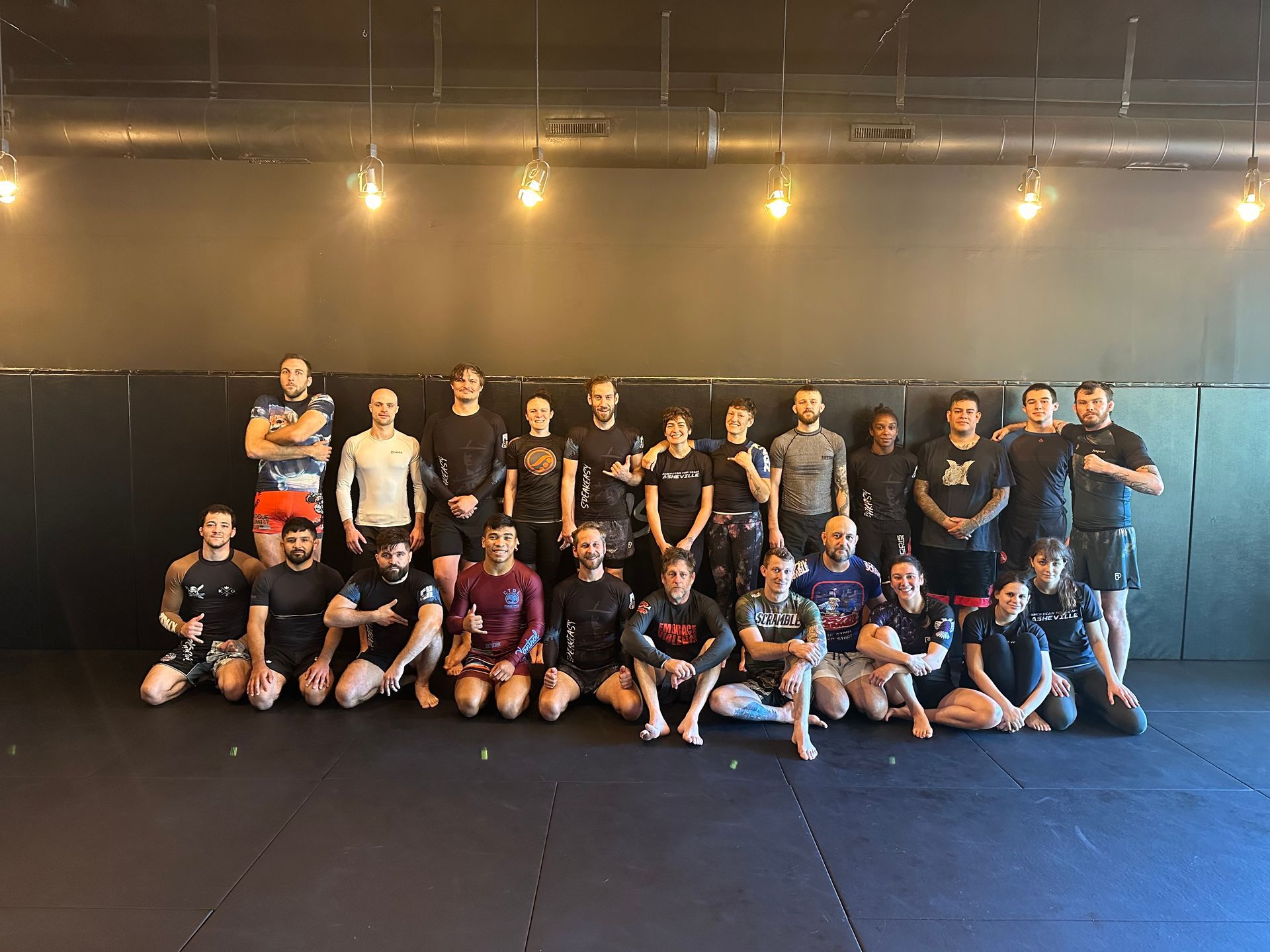
Real confidence is built when you practice staying calm, thinking clearly, and solving problems under pressure.
Self-confidence is one of those things people talk about like it is a personality trait, but in real life, it is usually a skill. In our adult Jiu-Jitsu classes, we see confidence change because you get repeated proof that you can learn, adapt, and handle discomfort without falling apart. That is a different kind of confidence than hype.
There is also research behind it. In studies on Brazilian Jiu-Jitsu practitioners, 87.6 percent reported improved confidence, and the same body of research shows reduced anxiety and better mood right alongside those gains. That pairing matters, because confidence does not grow well in a body that is constantly stressed out.
If you are looking for adult Jiu-Jitsu in Asheville, it helps to know what actually builds self-belief and what is just motivational talk. Below are seven practical, lived-in ways Jiu-Jitsu tends to change how you carry yourself in the gym and outside it.
Why Jiu-Jitsu confidence feels different from a pep talk
Jiu-Jitsu does not ask you to pretend you are fearless. It asks you to engage with real resistance in a controlled environment. When you roll with a training partner, you find out quickly what you know, what you forgot, and what you can figure out anyway. That feedback loop is honest, but it is also safe when it is coached well.
A useful detail from the research: more experienced practitioners show higher self-efficacy than newer ones, and black belts score significantly higher than white belts. That is not magic. It is what happens when you stack thousands of small wins and lessons over time.
In our Jiu-Jitsu in Asheville programs, we build that stack on purpose: clear fundamentals, repeatable training rounds, and a culture where you can take a deep breath and try again.
1. You earn confidence through measurable progress
One underrated confidence boost is simple measurement. Jiu-Jitsu has a structured progression system, and you can feel the difference between “I watched a move once” and “I can hit it against resistance.” Adults tend to love that clarity because so many parts of life are vague. Work projects shift, schedules change, people move the goalposts. On the mat, the goal is the goal.
We coach fundamentals in a way that gives you early milestones: posture, frames, escapes, guard retention, basic submissions, and positional control. When you start recognizing positions and making better decisions, your confidence is not based on hope. It is based on competence.
And yes, sometimes the smallest milestone is the biggest one: you survive a tough round without panicking, or you remember to breathe when you are stuck. That counts. Your nervous system learns too.
2. You get comfortable in uncomfortable situations
A core mechanism behind real self-confidence is learning to stay functional when things feel uncomfortable. Research interviews with BJJ practitioners repeatedly point to this theme: becoming comfortable in uncomfortable situations builds resilience and self-assurance.
In Jiu-Jitsu, discomfort is built into the training, but it is scaled. You might start with positional rounds that limit chaos, then expand into more open sparring as you learn. Over time, your brain stops treating pressure as an emergency and starts treating it as a puzzle.
This matters off the mat, too. When you have practiced thinking under pressure, everyday stressors often feel more manageable. You still feel stress, but you do not feel helpless. That shift is a quiet confidence, the kind that shows up in how you speak, how you drive home, how you handle a hard conversation at work.
3. You learn problem-solving, not just techniques
People sometimes think Jiu-Jitsu is a list of moves. It is not. It is decision-making: timing, leverage, angles, weight distribution, and choosing the right option with imperfect information. That is why practitioners often report enhanced mental flexibility in the research, with one study showing 81.3 percent noting improvements.
When you train consistently, you start recognizing patterns. You learn that if someone clears your grips, you can re-grip. If your first sweep fails, you chain to the second. If you cannot finish, you improve position. That habit of building Plan B and Plan C becomes part of your personality in a good way.
In our adult program, we teach this as “solve the position.” Instead of memorizing ten random moves, you learn principles you can actually use when the round gets messy. Your confidence grows because you trust your ability to adapt.
4. You build a calm mind through presence and flow
One of the best benefits of Jiu-Jitsu is also one of the hardest to explain until you feel it. During drilling and rolling, you cannot multitask. You are present or you get swept. That focus can create a flow state that feels meditative, even though you are working hard.
The mental health research aligns with this: 96.9 percent of practitioners reported improved mood, and 87.5 percent experienced reduced anxiety. When anxiety drops and mood improves, confidence has room to grow. You start showing up to life with a steadier baseline.
For many Asheville adults, this is the first hour all week where the phone is not in charge. You leave class physically tired, but mentally clearer. It is an oddly refreshing combination.
5. You gain confidence from community, not comparison
Confidence is not only an internal thing. It is also social. When you feel supported and respected, you take more healthy risks: asking questions, trying new skills, showing up even when you feel rusty. In one study, 100 percent of participants reported a sense of community in BJJ.
We take that seriously because adult beginners do not need to be “tested” by a harsh culture. You need an environment where training partners help you learn safely, where tapping is normal, and where improvement is the point. When you experience that, your self-confidence becomes more stable because it is not built on outperforming someone else.
A practical note: community confidence is also consistency. When you know people notice if you are there, you show up more often. And when you show up more often, you improve more. That is a nice loop.
6. You develop physical competence that changes how you carry yourself
Self-confidence is not only mental. It is also physical. When your body learns balance, posture, and controlled intensity, you start moving differently in daily life. You walk with more intention. You feel more capable when carrying groceries, hiking, or just navigating a crowded downtown sidewalk.
Jiu-Jitsu is especially helpful for adults because it rewards leverage and technique, not just speed or strength. That means progress is available even if you have not trained since high school, even if you sit at a desk, even if your knees complain a little on rainy days. We tailor training intensity and partner selection so you can build athleticism without feeling crushed.
This physical competence matters for self-defense confidence as well. You are not relying on wishful thinking. You have practiced escapes, control, and strategy against real resistance. You understand distance and grips. You know what it feels like when someone is trying, and you have options.
7. You learn to fail safely, then bounce back faster
Adults often avoid new things because failing feels expensive. Jiu-Jitsu flips that. You fail constantly, but safely, and you learn that failure is feedback. You tap, you reset, you try again. There is no shame in it when the room is coached correctly.
This is where mental toughness grows. Research on mental toughness in BJJ highlights self-confidence and resilience as core benefits. The mat becomes a practice lab for bouncing back. You learn to separate “I lost that exchange” from “I am not capable.” That distinction is huge.
Here is what that “fail safely” process looks like in real training:
1. You learn the safety basics first, including tapping early and communicating with your partner.
2. You drill a technique slowly so the mechanics make sense.
3. You add progressive resistance so you can feel what changes when someone pushes back.
4. You roll with guidance so you can apply skills without chaos taking over.
5. You review what happened and pick one adjustment for the next round.
That cycle builds confidence because it gives you control over improvement. You are not guessing. You are practicing.
Common concerns Asheville adults have before starting
If you are considering Jiu-Jitsu in Asheville, a few worries are incredibly common, and it helps to name them plainly.
• “I am not in shape yet.” You do not need to be. Training is how you get in shape, and we scale intensity so you can build capacity without burning out.
• “I do not want to get injured.” Smart coaching, safe training partners, and learning fundamentals first are the best injury prevention tools we have, and we use them.
• “I am too old to start.” Adults start in their 30s, 40s, 50s, and beyond. Technique is the point, and progress is real at every age.
• “I am nervous about sparring.” That is normal. We introduce sparring gradually and make sure you understand how to protect yourself.
• “I do not know if I will fit in.” Community is a major confidence driver in Jiu-Jitsu, and we put real effort into making the room welcoming.
If your goal is self-confidence, these concerns are not signs you should avoid training. They are reasons training tends to work.
How we help you turn confidence into a habit
Confidence fades when it is occasional. It grows when it is consistent. So we design our adult program to be repeatable: fundamentals you revisit, skills you refine, and rounds that teach you something each time.
We also keep expectations realistic. You are not going to feel like a superhero after one class. You will feel challenged, maybe a little awkward, and probably proud that you showed up anyway. Then the second class feels easier. By week four, you start noticing decisions you are making automatically. That is where the confidence starts to get sticky.
And if you like data, the broader research supports what we see daily: 87.6 percent report increased confidence from BJJ, and practitioners often experience reduced anxiety and improved mood alongside it. That combination is exactly what many adults are chasing, even if they do not use those words.
Take the Next Step
Building self-confidence through Jiu-Jitsu is not about becoming a different person overnight. It is about collecting real experiences that prove you can learn, stay calm, and handle pressure with skill. When you train consistently, you start trusting yourself, and that trust shows up everywhere: posture, decisions, relationships, and the way you handle hard days.
If you want a place to start that journey in Asheville, we built our adult program at Speakeasy Jiu-Jitsu & Wrestling Academy to be welcoming, structured, and challenging in the right ways. Show up as you are, and we will help you build the kind of confidence that lasts.
Curious about Jiu-Jitsu training? Join a class at Speakeasy Jiu-Jitsu & Wrestling Academy and learn from the ground up.